


Did you know? Your child’s gut is at the center of your child’s growth
You have thought about everything. The dal, the roti, the sabzi. You have tried to make sure your little one eats on time. You have consulted your pediatrician when the weight didn't go up. You have spent evenings researching health drinks and other hacks online.
And yet - your child still catches a cold every few weeks. Still complains of a tummy ache after lunch. Still throws a tantrum that leaves the whole house exhausted.
What if the problem was never about what your child is eating - but whether their body is actually absorbing it?
For millions of mothers, this is the missing piece. And the answer lies deep inside your child's gut — in a world of billions of good and bad tiny bacteria that most health conversations completely overlook.
Here are four things that pediatricians and nutritionists are increasingly talking about:
a) Why nutrient absorption is the real challenge for Indian children
b) How poor digestion silently affects your child's daily life
c) What signs you may be dismissing as normal, and
d) How probiotics can help
Part 1: Your Child Is Eating - But How Much Is Actually Being Absorbed?
Why Nutrients Matter, But Nutrient Absorption Matters More
When we talk about a child not getting enough nutrition, the conversation almost always focuses on the same things: protein, calcium, iron, vitamins. These nutrients are undeniably important. But there is a step that comes before any of this that most parents never hear about - absorption.
Think of it this way: feeding your child nutritious food is like depositing money into a bank account. But if the bank has a broken system, the deposits never register. Your child's gut is that system. And in a significant number of Indian children, that system is not working as well as it should.
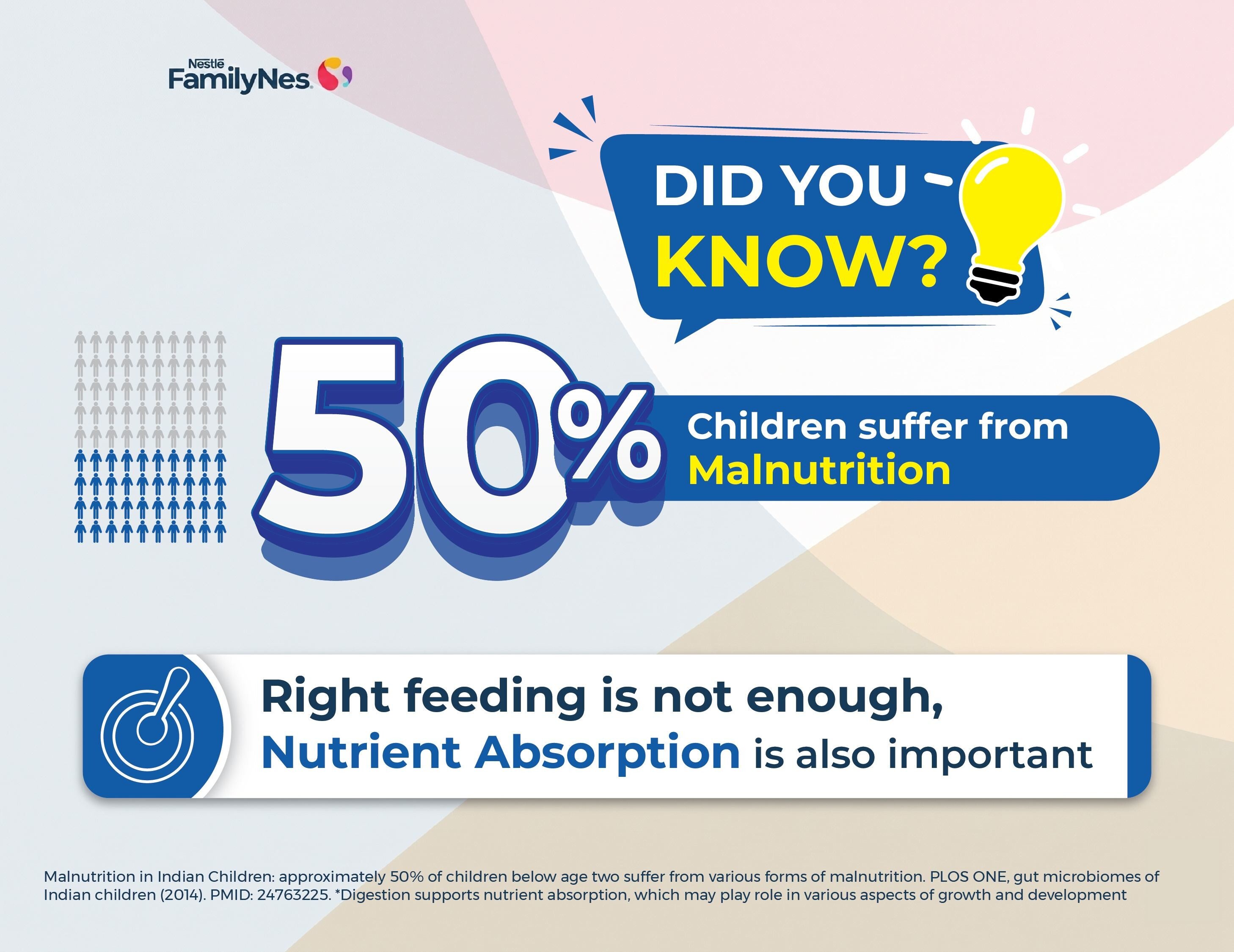
How the Gut Microbiome Drives Absorption
Your child's gut hosts approximately 100 trillion microorganisms - more than ten times the number of cells in the entire body. These bacteria do far more than just help digest food. They:
- Synthesize essential vitamins including B3, B5, B6, B12, and Vitamin K [4]
- Break down complex dietary fibres that the human gut cannot process on its own [4]
- Regulate the absorption of critical minerals including iron, calcium, and zinc
When this ecosystem is in balance - your child's body extracts maximum nutrition from every meal. When it is disrupted - even the most carefully cooked meal delivers only a fraction of its nutritional value to the body.
This is a vicious cycle: poor gut health leads to poor nutrient absorption, which weakens the child further, which makes the gut more vulnerable to infections, which further impairs absorption. [5]
Part 2: The Silent Problem - How Poor Digestion Goes Unnoticed
Here is the uncomfortable truth: gut dysfunction in young children rarely announces itself loudly. It does not come with a fever or a rash that sends you to the doctor. Instead, it shows up in ways that most parents - and even many doctors - attribute to mood, a phase, or bad luck. Research confirms that gut bacteria produce neurotransmitters that directly affect mood, focus, and behaviour. [7] A child with a disrupted gut microbiome is not simply being difficult. Their biology is sending them distress signals that they have no words for.
The reason poor digestion goes unnoticed is that its symptoms look exactly like things we already expect of young children:
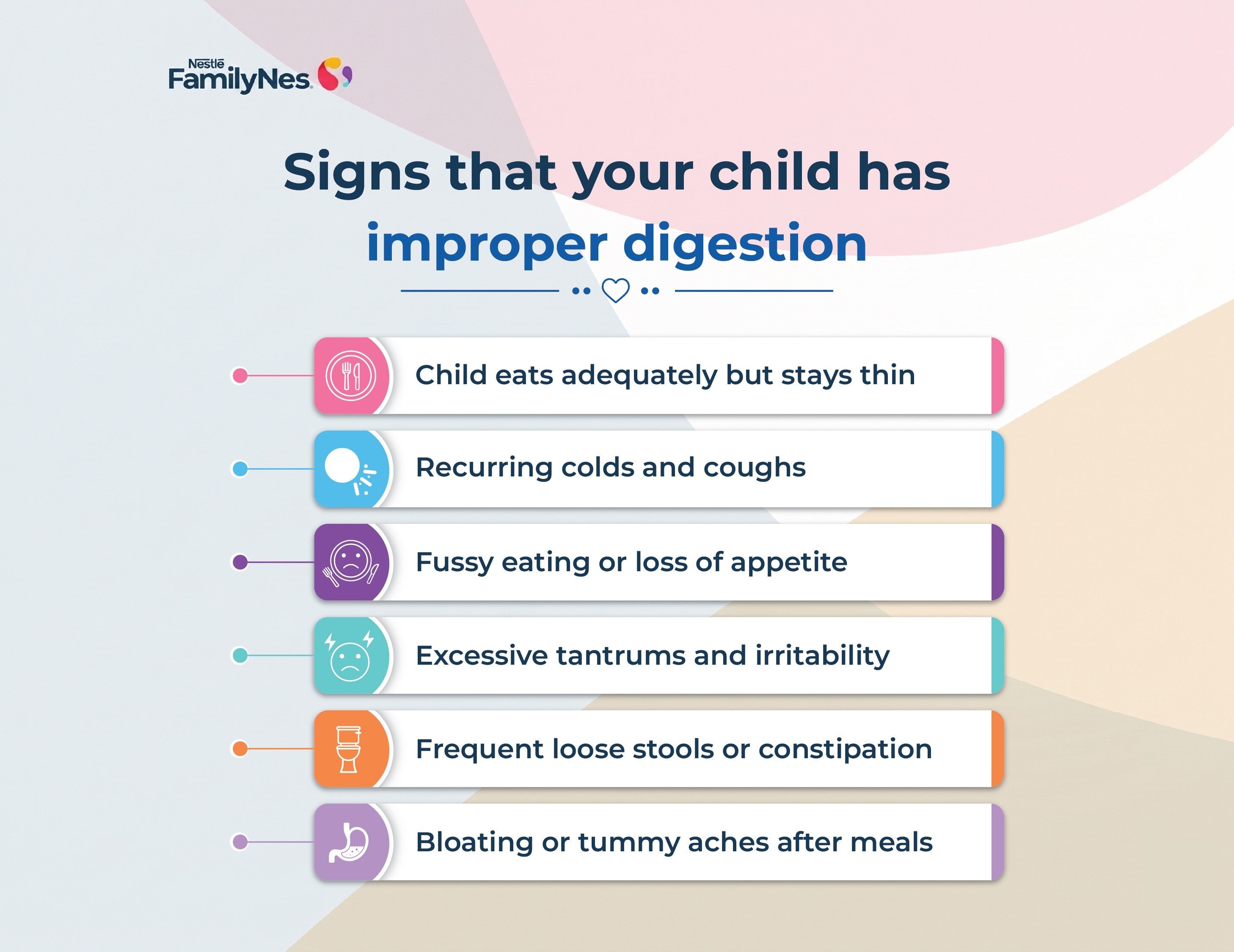
Know how digestion plays a role in these factors
What You See | What May Be Happening | What to Watch Out For |
|---|---|---|
| Child eats adequately but remains underweight | Nutrients are not being absorbed efficiently — the gut lining may be compromised | No weight gain despite consistent meals |
| Frequent loose stools or constipation | Gut microbiome imbalance causing irregular motility (movement of food in the stomach and intestines) and inflammation | More than 2 episodes of constipation per week |
| Recurring colds and coughs | Up to 70% of the immune system resides in the gut — a disrupted gut weakens immune response | More than 6–8 infections per year |
| Fussy eating or loss of appetite | An inflamed gut sends distress signals to the brain, reducing appetite signals | Child actively resisting food types they once ate |
| Excessive tantrums and irritability | The gut produces ~90% of the body's serotonin (chemical linked to mood); dysbiosis (imbalance of good and bad bacteria) disrupts this signalling pathway (chemical reactions in which a group of molecules in a cell work together to control a cell function) | Mood episodes not explained by sleep or hunger |
| Bloating or tummy aches after meals | Undigested food fermenting in a dysbiotic gut (imbalance of good and bad bacteria in the gut), causing gas and discomfort | Regular post-meal complaints of stomach pain |
Part 3: Signs You May Be Missing — And What They Mean for Growth
The Checklist Every Parent of a growing child Should Read
Below are signs that, individually, may seem minor. Together, they often point to a gut that needs support. If your child shows three or more of these regularly, it is worth discussing gut health with your pediatrician.
Gut Health Warning Signs in Children (2–6 Years) |
|---|
⚠ Tummy aches or cramping 2+ times a week |
| ⚠ Stools that are very hard, pellet-like, or on the other extreme, consistently loose |
| ⚠ Visible bloating or discomfort after meals |
| ⚠ Appetite that has decreased noticeably over the past 1–2 months |
| ⚠ Slow weight gain despite adequate food intake |
| ⚠ Recurring respiratory infections (colds, coughs, ear infections) — more than once a month |
| ⚠ Persistent skin issues such as eczema, rashes, or redness without clear cause |
| ⚠ Extreme irritability, mood swings, or behavioural changes in the afternoon |
| ⚠ Difficulty concentrating or maintaining attention at preschool |
| ⚠ Sleep disturbances — waking frequently at night, difficulty settling |
What These Signs Mean for Long-Term Growth
The early years are a critical window in a child's development. The brain grows rapidly. Bones are being built. The immune system is being trained. And all of this depends on a continuous, efficient supply of micronutrients - which depends on the gut.
Research published in Annual Review of Nutrition (2023) confirms that gut microbiome immaturity in early childhood is associated not just with stunted physical growth, but with reduced cognitive potential and long-term immune vulnerability. [9]
In plain terms: if your child's gut is not supported during these years, no amount of nutritious food will deliver its full potential.
Part 4: Supporting Your Child’s Gut - The Role of Probiotics
If your child’s gut microbiome drives nutrient absorption, immunity, and even mood, the next question is: how can you support it? This is where probiotics play a role.
What Are Probiotics - And Why Do They Matter?
Probiotics are live beneficial bacteria that, when consumed in adequate amounts, provide health benefits. They act as reinforcements for the good bacteria already present in your child’s gut, helping maintain a healthy balance.
This balance is critical because:
- Up to 70% of the immune system resides in the gut, making it central to protecting your child from infections
- Digestion depends on microbial balance, which helps break down food and improve nutrient absorption
- The gut–brain connection influences mood, sleep, and focus, with the gut producing ~90% of serotonin (chemical linked to mood)
In essence, probiotics support whether your child’s food is effectively converted into growth.
Not All Probiotics Are Equal — Why the Strain Matters
“Probiotic” is a broad category—different strains work differently. Scientific evidence supports specific strains, not generic claims.
One of the most well-researched strains for children is Lactobacillus reuteri (L. reuteri DSM 17938).
What Makes L. reuteri Stand Out?
L. reuteri is naturally found in the human gut and present in breast milk, making it well-suited for young children. It is also among the most clinically studied probiotic strains, with extensive global research.
Key Benefits for Children
Clinical evidence shows L. reuteri can:
- Reduce the frequency and duration of diarrhoea
- Lower respiratory tract infections
- Be safe for children aged 2–5 years
- Support bone density and muscle strength
- Improve gut microbiome diversity
- Help regulate the immune response
What This Means for Your Child |
|---|
A gut supported by a proven probiotic like L. reuteri can help: |
|
|
|
|
|
How to Include Probiotics Daily |
|---|
|
Products like NESTLÉ LACTOGROW provide L. reuteri DSM 17938 along with key nutrients like calcium, iron, and Vitamin D, making them a convenient option to support gut health as part of your child’s daily milk routine.
When choosing a probiotic, look for:
- A named, clinically studied strain
- Added nutrients supporting growth
- No unnecessary sucrose
You can also request a free sample for Nestlé LACTOGROW.
Note: Always consult your pediatrician before introducing new supplements.
Tell us what you think
It only takes a few seconds and helps us support you better

Important Notice
This content is not a substitute for professional medical advice. Please consult your healthcare professional.
Disclaimer: Mothers are informed that breast milk, especially the yellowish colostrum secreted in the first week after delivery, is highly nutritious and contains more protein, anti-infective properties, and Vitamin A. Breast milk is a complete food for the first six months, protects against infections, is always available, and requires no preparation. It is also more economical than infant milk substitutes.
Breastfeeding immediately after delivery helps the womb contract and supports the mother in regaining her figure quickly. Frequent suckling and maternal confidence are key to success. Mothers should be encouraged and supported, with proper care of breasts during pregnancy. Infants should be breastfed as soon as possible after birth, and mother and child should stay together (rooming-in). Colostrum must be given and not discarded in favor of sugar water or other substitutes. Infants should be fed on demand, and hygiene for both mother and child must be maintained.
References
- * Malnutrition in Indian Children: approximately 50% of children below age two suffer from various forms of malnutrition. PLOS ONE, gut microbiomes of Indian children (2014). PMID: 24763225
- * Taneja S, et al. Gut microbiomes of Indian children of varying nutritional status. PLOS ONE. 2014; doi:10.1371/journal.pone.0095547
- * Subramanian S, et al. Persistent gut microbiota immaturity in malnourished Bangladeshi children. Nature. 2014. | Longitudinal Analysis of the Intestinal Microbiota in Persistently Stunted Young Children in South India. PMC4881907
- * Chandrasekhar Srinivas, et al. Malnutrition in Indian children: gut health implications. International Journal of Medical Sciences, 2025; doi:10.5281/ijms.2025 | Iddrisu I et al. Malnutrition and Gut Microbiota in Children. Nutrients. 2021;13(8):2727
- Jones HJ, Bourke CD, Swann JR, Robertson RC. The intersection of undernutrition, microbiome, and child development in the first years of life. Nature Communications. 2023; doi:10.1038/s41467-023-39285-9
- Zoghi S et al. Gut microbiota and childhood malnutrition: understanding the link and exploring therapeutic interventions. Engineering in Life Sciences. 2024; PMC11065333
- Cryan JF et al. The gut-brain axis in mental health. Nature Reviews Neuroscience. 2019. | L. reuteri tryptophan-serotonin (chemical linked to mood) pathway: Frontiers in Immunology, Limosilactobacillus reuteri in immunomodulation. 2023; doi:10.3389/fimmu.2023.1228754
- Jones HJ et al. Annual Review of Nutrition. 2023 Aug 21;43:327–353. doi:10.1146/annurev-nutr-061121-091234
- Addae HY, Apprey C, Kwarteng A. Gut Microbiome-Targeted Nutrition Interventions and Growth among Children in Low- and Middle-Income Countries: A Systematic Review and Meta-Analysis. Current Developments in Nutrition. 2024
- L. reuteri DSM 17938 origin: Italian Journal of Pediatrics. 2019. doi:10.1186/s13052-019-0716-9
- Safety of Lactobacillus reuteri DSM 17938 in Healthy Children 2 to 5 Years of Age. PMC6557701. Conducted under FDA IND.
- Gutierrez-Castrellon P et al. Diarrhea in preschool children and Lactobacillus reuteri. RCT in 336 children aged 6–36 months. Reviewed in PMC4165878
- Safety study: Lactobacillus reuteri DSM 17938 in children aged 2–5 years. PMC6557701
- A young child formula supplemented with L. reuteri DSM 17938 and galacto-oligosaccharides modulates gut microbiome and supports bone and muscle development in toddlers (ages 2–3). medRxiv preprint. December 2024. doi:10.1101/2024.12.11.24318836
- Marti M et al. Effects of Lactobacillus reuteri supplementation on the gut microbiota in extremely preterm infants. PMC7974321
- Hao W et al. Limosilactobacillus reuteri in immunomodulation: molecular mechanisms and potential applications. Frontiers in Immunology. 2023; doi:10.3389/fimmu.2023.1228754
Related articles

Essential Nutrients for Optimal Growth in Children During the First Five Years
Discover essential nutrients that support healthy growth, strong bones, and brain development in 5-year-old children with simple food tips.
6 mins to read

Nourishing Young Brains: Why Do Iron, Iodine, and Vitamin B1 Matter?
Brain development in children under 6 years old is critical, and nutrition is one of the factors.
5 mins to read

Baby Eating Very Little? A Parent's Guide to Essential Nutrients and First Foods
Learn why nutrient-dense foods matter for babies 6 to 24 months, with iron-rich food tips suitable for Indian families, and safe ways to make every spoon count.
4 mins to read

Starting Solids at 6 Months: Signs of Readiness & First Foods Guide
When to start solids, key readiness signs to watch for, best first foods, and tips for handling food refusal in 6-month-old babies.
4 mins to read

Do Babies Need Fortified Cereals? What Indian Parents Should Know?
Do Babies Need Fortified Cereals? What Indian Parents Should Know?
8 mins to read

Baby's First Foods: A Parent's Guide to Key Nutrients
Find out the best first foods for babies and the key nutrients they need for healthy brain growth, digestion, and strong immunity.
6 mins to read

Baby Gut Health and Sleep: What Indian Parents Should Know
The gut microbiota, a group of microorganisms that reside in the gastrointestinal tract, influence many physiological processes, including immune response, digestion, and even neurological health.
5 mins to read

Signs and Symptoms of Gut Health Issues in Babies
Signs and Symptoms of Gut Health Issues in Babies
6 mins to read

Understanding Your Baby's Gut Health and Its Impact on Immunity
Understanding Your Baby's Gut Health and Its Impact on Immunity
4 mins to read

Cognitive development in children under six years: role of iron, iodine, vitamin B12
Boost your child's cognitive development with essential nutrients like iron, iodine, and vitamin B12. Learn how proper nutrition supports brain growth and learning,
6 mins to read

Immuno-nutrients: Nutrients Every Child Needs for a Strong Immune System
A strong immune system is essential for keeping children healthy and resilient against infections and illnesses.
5 mins to read

First foods - 8 ways to introduce variety and texture
Introducing new textures and foods helps your baby eat better. Try these 8 simple tips to add variety and support healthy eating habits.
5 mins to read