


Little kids need to eat sufficient nutritious food every day to grow up to be strong, healthy, and smart adults. Your baby's energy and nutritional demands are at an all-time high from 6 months to 24 months of age as they grow rapidly around that time. Additionally, at six months, your kid reaches a significant developmental milestone - the introduction of solid meals. Undoubtedly, the best nourishment comes from breast milk, but now is the time to look at complementary feedings to help breastmilk to support growth through a balanced diet.(1) Not only do these early food experiences address developmental needs, but they also lay the groundwork for lifelong good eating habits.
Is Your Baby Ready for Solid Foods?
First, it is important to notice if your baby is ready for their transition to solid foods. Your baby should be able to sit with good head control, seem eager to be fed by opening their mouth when food comes their way. Always remember, it is their first time having something thicker than breastmilk, so they may take some time to get used to it.(2) Now that you know your baby is ready or not, the next step would be to know if the food you’re choosing has the essential nutrients or not.
What Should Parents Look for When Choosing Baby's First Foods?
The primary requirement is to always choose food that is high in nutrients to support the fast growth and development rate of your baby.
Which Nutrients Are Essential in a Baby's First Foods?
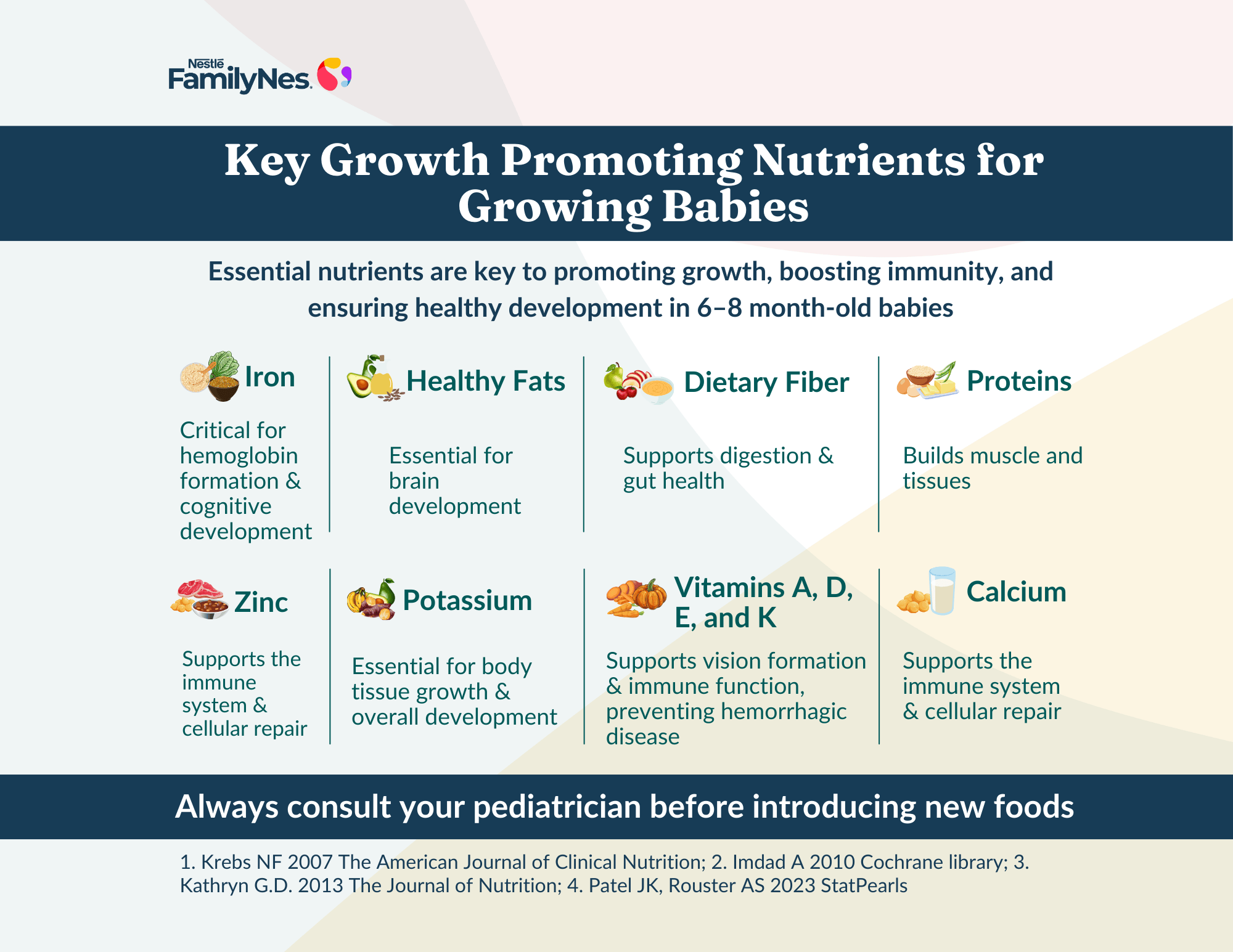
Now, what are the key nutrients that can be introduced? Well, nutrients such as
a) Healthy fats (such as paneer, ghee, nuts, and seeds),
b) Dietary fibers (whole grains like barley, oats, and brown rice),
c) Iron (palak, masoor dal, chana, beetroot, methi leaves, and ragi),
d) Protein (dal, paneer, eggs, peas, soya chunks, fish, and peanuts),
e) Calcium (tuar dal, curry leaves, bajra, egg, soyabeans, rajma, black gram dal, green gram, and milk),
f) Vitamins A, D, E, and K (green leafy vegetables, carrots, pumpkin, and seasonal fruits such as papaya, mango, chikoo, and banana),
g) Zinc (pumpkin seeds, beans, or lentils [red, green, and black lentils], black-eyed peas, and split peas), and
h) Potassium (sweet potatoes, spinach, coconut water, white beans, tomato paste, and potatoes)
These are the key components for the initial growth and development phase of your baby. The role of each nutrient is represented in the illustration for better understanding.
How should parents introduce the first foods?
Start with Single-Ingredient Purees:
Begin with basic single-ingredient purees, like carrots, mashed banana, other pulpy fruits (e.g., mango, papaya), and sweet potatoes- gentle on tiny stomachs yet full of nutrients, to help your baby adapt to new tastes. This is where pureed cereals and mashed fruits and vegetables (such as mashed and boiled pumpkin, mango/papaya/chikoo [sapodilla], and steamed mashed apple/banana) are easily prepared and are thought to be helpful for growth, building strong immunity, and brain development. It is always beneficial to choose organic food options and seasonal foods as they have increased nutritional content and are typically free from synthetic pesticides, fertilizers, and other chemicals, which can be better for your baby’s health and the environment.
As soon as they get the hang of these foods, spice things up by adding an appropriate combination of cereals and pulses (Khichdi, Dal rice, etc.), locally available staple foods such as idli, dosa, dhokla, ragi, and chapati for even extra delicious discoveries.(3), (4)
- For example, a meal that combines cereal (rice/wheat) based food mixed with pulses/nuts, vegetables, and cooked in oil/ghee makes it a balanced food, such as, Upma, Pulao, Biryani, and Poha. Individually, rice and pulses lack certain essential amino acids, but when eaten together, they complement each other perfectly, providing a well-balanced protein source.(4)
Why Are Fortified Cereals Recommended After 6 Months?
After confirming with your pediatrician, you can also start offering micronutrient-fortified foods such as iron-fortified cereals after six months to support the necessary nutrition needed.
Why should this be done? After reaching six months, your baby's nutrient stores especially iron, start running low, so adding these cereals will support to meet the high nutrient needs. These cereals are nutrient-dense and energy-dense and are made especially to adapt to the changing nutritional needs of babies and thereby preventing the risk of any nutrient deficiency.
How Do Pulses and Leafy Greens Support Baby Nutrition?
A nutrient-dense combination of whole pulses and leafy greens yields a nutritious lunch high in protein, calcium, and iron. Kidney beans, chickpeas, chana, green gram, and cowpeas, when soaked overnight and thoroughly cooked, improve digestion and nutrient absorption. Pairing these with leafy greens like spinach, fenugreek, or amaranth increases their nutritional worth. Serving this as a meal, soup, or mashed dish ensures a well-rounded diet, while adding a teaspoon or two of ghee aids digestion and provides good fats for overall nutrition.
Why Is Early Taste Exposure Important for Babies?
Your baby’s taste buds are super sensitive at this point. Therefore, it is important to provide a range of flavors for newborns to taste. This promotes quick acceptance of family foods in their later years. Also, keep in mind to avoid incorporating artificial flavors or sugars in your baby’s diet. The World Health Organization (WHO) recommends avoiding added sugar and salt diets for kids under 2 years. This not only prevents their taste buds but also helps establish healthy eating habits and protects their tiny growing kidneys.(5)
Should breastfeeding continue after introducing solids?
Breastfeeding should be continued even while introducing solid foods to provide your kid with a balanced and nutrient-packed diet. By maintaining this perfect combo, you’re giving them the best of both worlds for their continuing growth and better health.
When Should You Consult Your Pediatrician About Baby Food?
Every baby is unique and so does their nutritional needs. Before introducing new foods or supplements, consult your pediatrician for personalized advice. They can guide you in aligning your baby's diet with their growth milestones.
Tell us what you think
It only takes a few seconds and helps us support you better

References
- Dewey KG. The challenge of meeting nutrient needs of infants and young children during the period of complementary feeding: an evolutionary perspective. J Nutr. 2013 Dec;143(12):2050–4.
- Borowitz SM. First Bites—Why, When, and What Solid Foods to Feed Infants. Front Pediatr. 2021 Mar 26;9:654171.
- Feeding your baby: 6–12 months | UNICEF Parenting [Internet]. [cited 2025 Jan 30]. Available from: https://www.unicef.org/parenting/food-nutrition/feeding-your-baby-6-12-months
- Tiwari SK, Sangle AL, Reddy UN, Shah D. Complementary Feeding: Feeding of an Infant Beyond 6 Months Age.
- WHO Guideline for complementary feeding of infants and young children 6-23 months of age [Internet]. [cited 2025 Jan 30]. Available from:- https://www.who.int/publications/i/item/9789240081864
Important Notice
This content is not a substitute for professional medical advice. Please consult your healthcare professional.
Disclaimer: Mothers are informed that breast milk, especially the yellowish colostrum secreted in the first week after delivery, is highly nutritious and contains more protein, anti-infective properties, and Vitamin A. Breast milk is a complete food for the first six months, protects against infections, is always available, and requires no preparation. It is also more economical than infant milk substitutes.
Breastfeeding immediately after delivery helps the womb contract and supports the mother in regaining her figure quickly. Frequent suckling and maternal confidence are key to success. Mothers should be encouraged and supported, with proper care of breasts during pregnancy. Infants should be breastfed as soon as possible after birth, and mother and child should stay together (rooming-in). Colostrum must be given and not discarded in favor of sugar water or other substitutes. Infants should be fed on demand, and hygiene for both mother and child must be maintained.
Other Related Topics

Experience the pure joy of feeding with natural goodness! Nourish your loved ones with care and love—because every bite matters. Try it today!