


Nourishing Young Brains: Why Do Iron, Iodine, and Vitamin B1 Matter?
What role does early nutrition play in your child’s brain development?
Brain development in children under 6 years old is critical, and nutrition is one of the factors that plays a significant role in shaping how the brain grows and functions. A child’s brain is highly plastic, meaning it can form new connections rapidly, especially during the first 6 years of life.
Optimal nutrition supports the development and function of your child’s brain. The brain grows quickly throughout pregnancy and the initial 2 years of life. Post those early years, especially up until 6 years of your child’s age, the brain undergoes a phase of development where creating neuron connections peaks, which support intellect, memory, and learning ability.1
Nutrition is one of the various stimulations that influence the optimal development and functioning of such connections and skills. Certain nutrients like iron, iodine, and vitamin B1 support brain development and the learning, concentration, and problem-solving abilities of a child.
What does Vitamin B1 (Thiamine) do for your child’s brain?
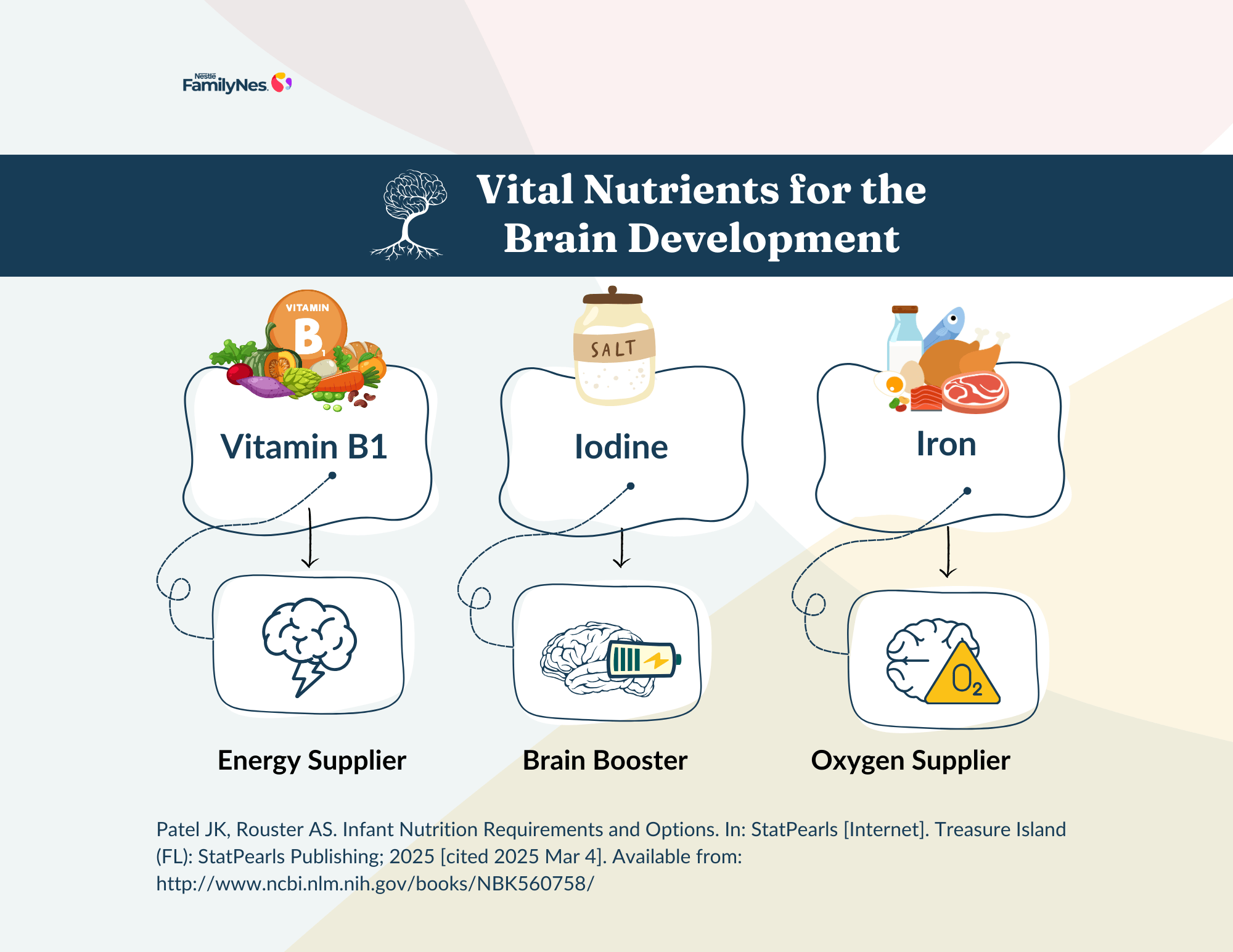
Vitamin B1 (Thiamine): The Energy Provider
Vitamin B1 (Thiamine) helps your baby's brain development, increasing energy metabolism and supporting neurotransmitters (essential for developing learning, focus, and memory skills) involved in brain function.2, 3
What happens due to the deficiency of vitamin B1? The deficiency of vitamin B1 may influence language and motor skill development4 and also on neurological functions.5
Why is iodine important for baby's brain growth?
Iodine is essential to making thyroid hormones, which help in brain growth & development.6 It also supports general mental sharpness, nerve protection, and brain cell development.
Iodine deficiency may affect the brain development and function leading to mental retardation, in cases of extreme Iodine deficiency. Iodine deficiency can also lead to growth delays.7
How does iron support the brain?
Iron: Oxygen for the Brain
Iron transports oxygen to the brain, promotes healthy red blood cells, and aids in brain activities such as neurotransmitter generation and myelin development.8
What if your baby is Iron deficient? Iron deficiency may lead to anemia, affecting your baby's social and daily life. Its deficiency can impact cognitive ability, memory, and learning skills.
How can parents include iron, iodine, and vitamin B1 in the regular diet?
As a parent, to support the growth potential of the brain, it is essential to provide the necessary nutrition to the baby during this growth phase.
Include a varied diet to support enough iron, iodine, and vitamin B1 intake by children. Some of the food sources of these nutrients are:
- Iron: Fish, poultry, lentils (dal), flattened rice (chirua/poha).
- Iodine: Iodized salt in meals, dairy products (milk, cheese, dahi), and eggs.
- Vitamin B1: Meat, fish, seeds, nuts, green peas, sunflower seeds, kidney beans (rajma), and soy products
Additionally, fortified milk and foods as an addition to daily diet can support optimal nutrition and intake of these nutrients to support optimum brain development and healthy growth.
How does fortified milk help meet your child’s nutritional needs?
Young children require a wide variety of foods to meet their high nutritional demands at this critical time for physical, cognitive, and motor development. Fortified milk and foods, when added to the daily regular diets, support the high nutrition requirements of this phase and reduce the risk of any nutritional deficiency and its long-term consequences.
Tell us what you think
It only takes a few seconds and helps us support you better

References
- Auctores. Auctores. [cited 2025 Mar 26]. The impact of nutrition on people’s cognitive development. Available from: https://www.auctoresonline.org/article/the-impact-of-nutrition-on-peoples-cognitive-development
- Baldwin DA, Measelle J, Gallivan L, Sanchirico A, Weinstein N, Kroeun H, et al. Maternal Thiamine Supplementation Promotes Infants’ Language Processing at 24 Weeks. Curr Dev Nutr. 2021 Jun 7;5(Suppl 2):892.
- Whitfield KC, Smith TJ, Rohner F, Wieringa FT, Green TJ. Thiamine fortification strategies in low‐ and middle‐income settings: a review. Ann N Y Acad Sci. 2021 Aug;1498(1):29–45.
- Fattal-Valevski A, Azouri-Fattal I, Greenstein YJ, Guindy M, Blau A, Zelnik N. Delayed language development due to infantile thiamine deficiency. Dev Med Child Neurol. 2009 Aug;51(8):629–34.
- C S, Kundana PK, Reddy N, Reddy B S, Poddutoor P, Rizwan A, et al. Thiamine-responsive, life-threatening, pulmonary hypertensive crisis with encephalopathy in young infants: A case series. Eur J Paediatr Neurol. 2022 Jan;36:93–8.
- Iodine and Mental Development of Children 5 Years Old and Under: A Systematic Review and Meta-Analysis - PMC [Internet]. [cited 2025 Mar 26]. Available from: https://pmc.ncbi.nlm.nih.gov/articles/PMC3705354/
- A national survey of iodine nutrition in children aged 3–6 years in China and its relationship with children’s physical growth - PMC [Internet]. [cited 2025 Mar 26]. Available from: https://pmc.ncbi.nlm.nih.gov/articles/PMC11574653/
- Piñero DJ, Connor JR. Iron in the Brain: An Important Contributor in Normal and Diseased States. Neuroscientist. 2000 Dec 1;6(6):435–53.
Important Notice
This content is not a substitute for professional medical advice. Please consult your healthcare professional.
Disclaimer: Mothers are informed that breast milk, especially the yellowish colostrum secreted in the first week after delivery, is highly nutritious and contains more protein, anti-infective properties, and Vitamin A. Breast milk is a complete food for the first six months, protects against infections, is always available, and requires no preparation. It is also more economical than infant milk substitutes.
Breastfeeding immediately after delivery helps the womb contract and supports the mother in regaining her figure quickly. Frequent suckling and maternal confidence are key to success. Mothers should be encouraged and supported, with proper care of breasts during pregnancy. Infants should be breastfed as soon as possible after birth, and mother and child should stay together (rooming-in). Colostrum must be given and not discarded in favor of sugar water or other substitutes. Infants should be fed on demand, and hygiene for both mother and child must be maintained.