


Baby Eating Very Little? A Parent's Guide to Essential Nutrients and First Foods
Baby meals can look tiny from the outside. A few spoonfuls of khichdi. Half a mashed banana. Two curious licks of dal. But for a growing baby, those small spoonfuls can carry a lot of responsibility.
At 6 months, babies have small stomachs, however, their nutritional needs are very high. This means that our focus should be on ensuring that every bite is packed with essential nutrients for your baby’s growth and development.
This article covers:
- Why Is Nutrient-Rich Baby Food Important at 6 Months?
- Which nutrients are essential in your baby's first foods?
- What are some nutrient rich baby foods for your 6-24-month-old?
Why Is Nutrient-Rich Baby Food Important at 6 Months?
A 6-month-old baby's stomach can only hold a limited amount of food, however, their nutritional needs per kg of body weight are much higher than that of an adult man.
According to ICMR-NIN 2020, a baby aged 6-12 months weighing approximately 8.5 kg needs4:
| Nutrient | Baby (6–12 months) Weight: 8.5kg | Adult Man | Comparison |
| Iron | ~0.35 mg/kg | ~0.29 mg/kg | Baby needs ~1.2x more iron |
| Protein | ~1.2 g/kg | ~0.83 g/kg | Baby needs ~1.5x more protein |
| Calcium | ~35.3mg/kg | ~15.4mg/kg | Baby needs ~2.3x more calcium |
Hence, due to both small size of the stomach and high nutritional requirements, every bite of baby food needs to deliver higher nutrition than food consumed by an adult man4.
Which Nutrients Are Essential in Your Baby's First Foods?
The key nutrients in your baby's first foods include iron, protein, calcium and vitamin D. These nutrients help support your baby's brain & cognitive development and normal height and weight gain.
For normal height gain:
Normal height gain in babies is associated with bone matrix formation and bone mineralization. The nutrients that help support these growth functions are:
| Growth Function | Key Nutrients |
|---|---|
| Bone Matrix Formation | Protein, Zinc, Vitamin C |
| Bone Mineralization | Vitamin D, Calcium, Phosphorus |
For normal weight gain:
Normal weight gain in babies is associated with developing muscle mass and muscle strength. The nutrients that help support these growth functions are:
| Growth Function | Key Nutrients |
|---|---|
| Muscle Mass & Strength | Protein, Calcium, Magnesium, Vitamin D |
For brain and cognitive development:
| Growth Function | Key Nutrients |
|---|---|
| Brain Function & Development | Iron, Vitamin B1, ALA |
What Are Some Nutrient Rich Baby Foods for your 6–24-month-old?
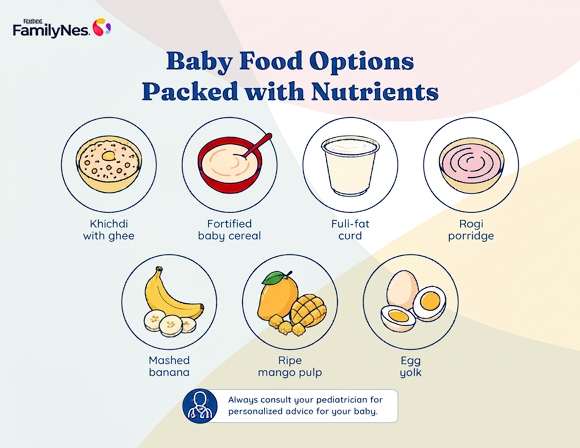
Some baby food options that are packed with nutrients are:
- Khichdi with ghee: Provides Carbohydrates, Protein, and Fat in one bowl³
- Fortified baby cereal: Contains essential macro and micronutrients like Protein, Iron, Vitamin D and Calcium
- Full-fat curd: Calcium and Protein in a texture babies accept easily¹
- Ragi porridge: Ragi is a rich source of Calcium for babies³, and babies can comfortably consume it in the form of a porridge.
- Mashed banana or ripe mango pulp: Natural sugars for energy alongside micronutrients¹
Egg yolk: Iron, Protein, and Healthy Fat in a small serving¹
For age-appropriate meal plans using these foods, you may find it helpful to explore meal plan options for 6–12-month-olds.
For personalized concerns, it is recommended to consult your pediatrician.
Tell us what you think
It only takes a few seconds and helps us support you better

References
- World Health Organization. WHO Guideline for Complementary Feeding of Infants and Young Children 6–23 Months of Age. Geneva: WHO, 2023. https://www.who.int/publications/i/item/9789240081864
- Mayo Clinic. Iron Deficiency in Children: Prevention Tips for Parents. Last reviewed February 2024. https://www.mayoclinic.org/healthy-lifestyle/childrens-health/in-depth/iron-deficiency/art-20045634
- Indian Academy of Pediatrics. Complementary Feeding: Feeding of an Infant Beyond 6 Months Age. IAP Parent Guideline Committee. https://iapindia.org/pdf/Ch-040-IAP-Parental-Guideline-Complementary-Feeding.pdf
- ICMR-NIN Expert Group on Nutrient Requirement for Indians. Recommended Dietary Allowances (RDA) and Estimated Average Requirements (EAR) — 2020. ICMR-National Institute of Nutrition, Hyderabad. Available at: https://www.nin.res.in/rdabook/brief_note.pdf
Important Notice
This content is not a substitute for professional medical advice. Please consult your healthcare professional.
Disclaimer: Mothers are informed that breast milk, especially the yellowish colostrum secreted in the first week after delivery, is highly nutritious and contains more protein, anti-infective properties, and Vitamin A. Breast milk is a complete food for the first six months, protects against infections, is always available, and requires no preparation. It is also more economical than infant milk substitutes.
Breastfeeding immediately after delivery helps the womb contract and supports the mother in regaining her figure quickly. Frequent suckling and maternal confidence are key to success. Mothers should be encouraged and supported, with proper care of breasts during pregnancy. Infants should be breastfed as soon as possible after birth, and mother and child should stay together (rooming-in). Colostrum must be given and not discarded in favor of sugar water or other substitutes. Infants should be fed on demand, and hygiene for both mother and child must be maintained.
Related articles

Starting Solids at 6 Months: Signs of Readiness & First Foods Guide
When to start solids, key readiness signs to watch for, best first foods, and tips for handling food refusal in 6-month-old babies.
4 mins to read

The Complete Science of Early Years’ Nutrition | Dr Ajay Prakash | Ep 2
Dr. Ajay Prakash addresses questions on first foods, iron-rich foods, cow’s milk, gut health and baby-led weaning.
19 mins to watch