


Introducing Solids at 6 Months: Signs Your Baby Is Ready and Which Baby Foods to Start With
Wondering when and how to start solids? Here is a guide to readiness signs, first foods, and handling refusal, all in one place.
Introducing your baby to solids for the first time is an exciting milestone. This guide helps answer some commonly asked questions parents have at this stage:
When should you start solids for your baby?
What are the signs that your baby is ready for solids?
What are the good first foods for a 6-month-old?
What if your baby refuses to eat?
When should you start solids for your babies?
Most health organizations, including the World Health Organization (WHO) and the Indian Academy of Pediatrics (IAP), recommend introducing nutritionally adequate and safe baby food at around 6 months of age, alongside continued breastfeeding.1,3
In addition, developmental readiness is an important indicator, as discussed in the next section.
What are the signs that your baby is ready baby for solids?
These signs are for guidance only. Before starting solids, consultation with pediatrician is advised.
Most pediatric guidelines suggest looking for a combination of developmental signs before beginning solids:
Baby has completed 6 months of age
Baby holds head and neck steady without support
Baby sits up with a little help
Their tongue thrust is reducing and is gaining the control it needs to swallow safely
Baby’s gaze follows spoon from plate to your mouth
They reach out to food in your plate
They feel hungry soon after milk feeds
- Their gums are becoming firm and strong to mash food
Always consult your pediatrician for personalized advice for your baby.
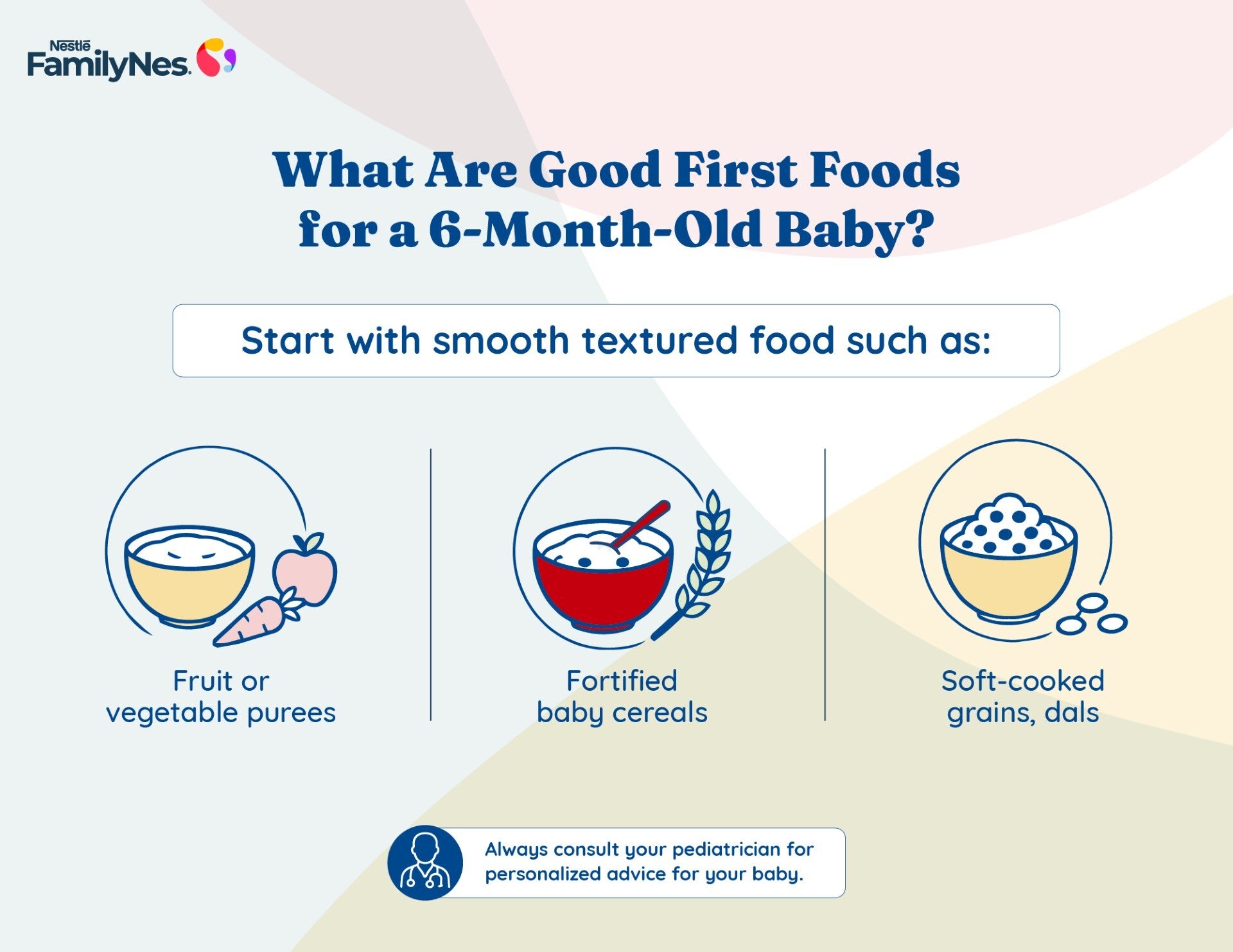
What Are Good First Foods for a 6-Month-Old Baby?
It is recommended that a baby’s first foods be single-ingredient foods for easy digestion as the digestive system of the baby is still developing. This also helps to identify if baby is allergic/ sensitive to any ingredient.
You can start with smooth and thin textured food in the first 2-4 weeks such as:
These can contribute to fulfilling the daily nutrient requirements of babies.
The consistency can gradually be thickened to support easy transition to homemade foods.
To know more about first foods and ways to introduce variety and texture, you can also refer to the article on First Foods – 8 ways to introduce variety and texture
What If Your Baby Refuses To eat?
Early food refusal is a common concern raised by parents. Research suggests offering a food, 8-12 times before deciding the refusal or dislike of that food by your baby. ⁴
What can help with the increasing acceptance of new food by your little one?
- Offer a new food, calmly and without pressure
- Offer any new food during morning time to check for any potential reaction/sensitivity and manage adequately with help of pediatrician.
- Offer the same food in various forms to check acceptance
- Keep your own reaction neutral; babies are very attuned to a parent's emotions
For personalized recommendations, it is always advisable to consult your pediatrician.
| Quick Checklist | |
|---|---|
| Parent check | Why it matters |
| Baby has completed 6 months and shows readiness signs. | Confirms it may be time to introduce solids. |
| Recommended first foods: single-ingredient, smooth, and thin textured. | Easier for a still-developing digestive system. |
| New food is offered patiently, up to 8-12 times. | Helps in building acceptance without pressure. |
Tell us what you think
It only takes a few seconds and helps us support you better

References
- World Health Organization. Infant and Young Child Feeding: Model Chapter for Textbooks for Medical Students and Allied Health Professionals. Geneva: WHO, 2009. https://www.who.int/publications-detail-redirect/9789241597494
- World Health Organization. WHO Guideline for Complementary Feeding of Infants and Young Children 6–23 Months of Age. Geneva: WHO, 2023. https://www.who.int/publications/i/item/9789240081864
- Indian Academy of Pediatrics. Complementary Feeding: Feeding of an Infant Beyond 6 Months Age. IAP Parent Guideline Committee. https://iapindia.org/pdf/Ch-040-IAP-Parental-Guideline-Complementary-Feeding.pdf
- Spill MK, Johns K, Callahan EH, et al. Repeated exposure to food and food acceptability in infants and toddlers: a systematic review. American Journal of Clinical Nutrition. 2019;109(Suppl 7):978S–989S. https://pubmed.ncbi.nlm.nih.gov/30982874/
Important Notice
This content is not a substitute for professional medical advice. Please consult your healthcare professional.
Disclaimer: Mothers are informed that breast milk, especially the yellowish colostrum secreted in the first week after delivery, is highly nutritious and contains more protein, anti-infective properties, and Vitamin A. Breast milk is a complete food for the first six months, protects against infections, is always available, and requires no preparation. It is also more economical than infant milk substitutes.
Breastfeeding immediately after delivery helps the womb contract and supports the mother in regaining her figure quickly. Frequent suckling and maternal confidence are key to success. Mothers should be encouraged and supported, with proper care of breasts during pregnancy. Infants should be breastfed as soon as possible after birth, and mother and child should stay together (rooming-in). Colostrum must be given and not discarded in favor of sugar water or other substitutes. Infants should be fed on demand, and hygiene for both mother and child must be maintained.