


What to Feed Your Baby During Loose Motion (Diarrhea): Age-wise Recovery Guide
It is normal to worry when your baby has diarrhea, especially about what to feed them. Should you stop solids? Is breast milk still okay? In this blog, we will guide you through what to offer, how long recovery might take, and why continuing to feed your baby is essential.
The primary and immediate concern with diarrhea is loss of fluid and electrolytes from the body. While rehydrating them is the most critical component of diarrhea, don't stop feeding. Your baby still needs nutrients to fight the infection, maintain energy, and recover faster.
What Should I Feed My Baby During Loose Motion? An Age-wise Guide
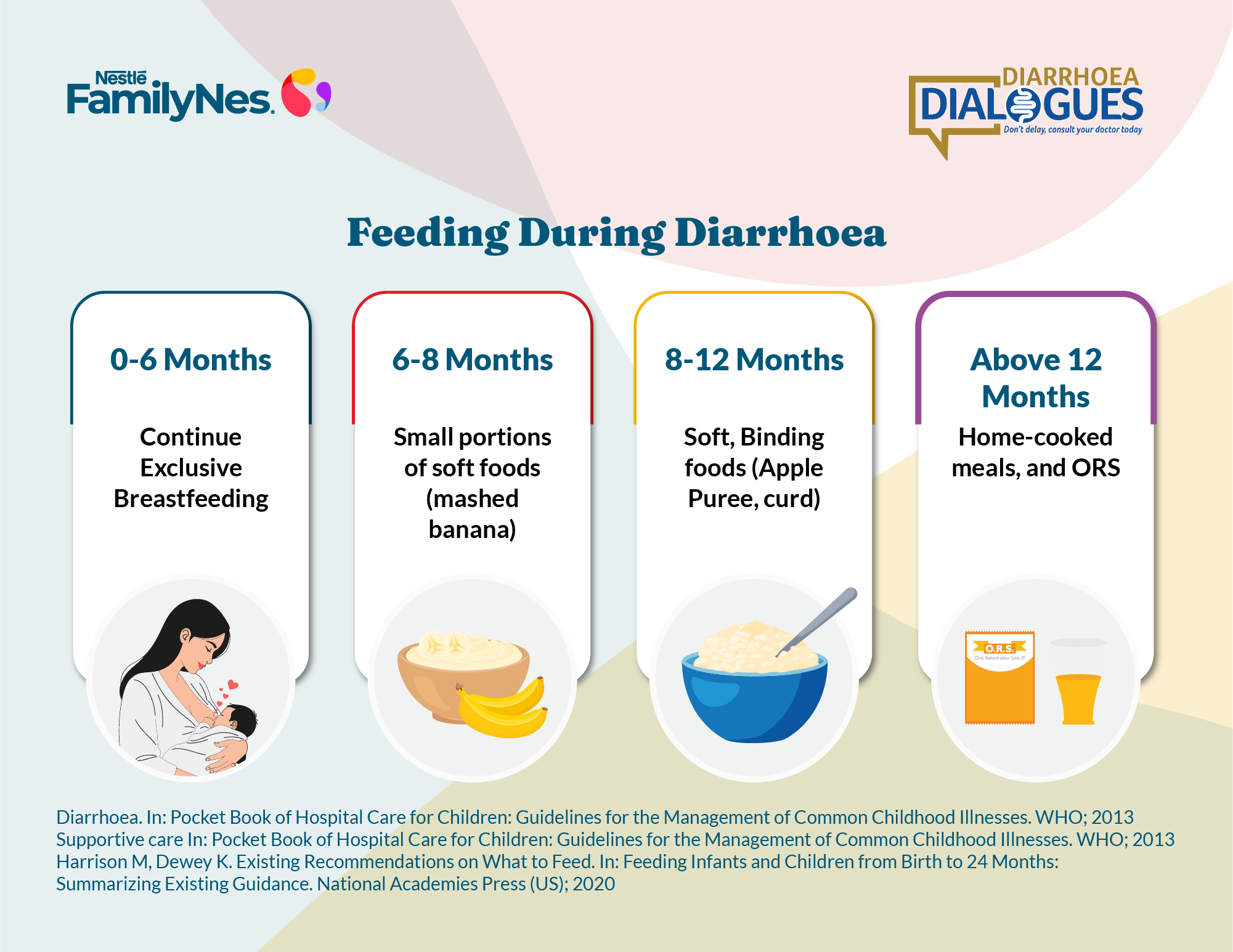
0-6 Months:
- If your child is breast-fed, continue during diarrhea, as breastmilk provides antibodies and fluids that protect against infections and maintain hydration.1,2
6-8 Months:
- Introduce other foods carefully, in small amounts, and observe if their symptoms reduce or worsen with time.
- Offer soft, common, light, easy-to-digest food or fruits like mashed banana.
- Avoid greasy, spicy, and high-fiber foods that can make diarrhea worse.3
8-12 Months:
- Provide foods with slightly more texture but bland that are also binding and soft food. Such as: Idli or soft khichdi, boiled potatoes, apple puree, curd.
12 Months and Above
- Encourage your child to eat soft home-cooked foods and offer rehydration fluids like ORS in between meals.5,2
In general, milk diets are an important part of dietary intake for young children. Milk contains lactose as the main carbohydrate. In some cases, babies may have temporary difficulty digesting lactose during diarrhea because the infection can reduce the enzyme available for digesting lactose in the intestine. However, a complete removal of lactose from the diet is usually not required.
Discuss with your pediatrician about using a reduced lactose diet until recovery. Lactose-free alternatives are not usually required.4
Should I Continue Breastfeeding During Loose Motion?
Definitely, yes! Breastfeeding during diarrhea is safe, recommended, and beneficial, so it should be continued if the child is breastfed. It provides hydration, antibodies, and easy-to-digest nutrition.3
Why Is Breast Milk Beneficial During Diarrhea
How Long Does Loose Motion Last in Babies?10, 11
Feeding and hydrating your baby during diarrhea helps them recover faster. Breast milk, simple foods, and ORS go a long way in supporting recovery. If you’re unsure, always check with your pediatrician.
Want to understand what causes loose motion in the first place? Read Understanding Baby Diarrhea.
For hygiene habits that help prevent loose motion, see our guide for Indian homes.
Tell us what you think
It only takes a few seconds and helps us support you better

References
- Diarrhoea. In: Pocket Book of Hospital Care for Children: Guidelines for the Management of Common Childhood Illnesses. 2nd Edition. World Health Organization; 2013. Accessed July 22, 2025. https://www.ncbi.nlm.nih.gov/books/NBK154434/
- Shah D, Sharma N, Rai AK, Oberoi A. Indian Academy of Pediatrics (IAP).
- Supportive care. In: Pocket Book of Hospital Care for Children: Guidelines for the Management of Common Childhood Illnesses. 2nd Edition. World Health Organization; 2013. Accessed July 22, 2025. https://www.ncbi.nlm.nih.gov/books/NBK154449/
- MacGillivray S, Fahey T, McGuire W. Lactose avoidance for young children with acute diarrhoea. Cochrane Database Syst Rev. 2013;2013(10):CD005433. doi:10.1002/14651858.CD005433.pub2
- National Academies of Sciences E, Division H and M, Board F and N, Age 2 C on SEG for FR for I and YCU, Harrison M, Dewey K. Existing Recommendations on What to Feed. In: Feeding Infants and Children from Birth to 24 Months: Summarizing Existing Guidance. National Academies Press (US); 2020. Accessed July 22, 2025. https://www.ncbi.nlm.nih.gov/books/NBK561312/
- Brown KH, Lake A. Appropriate use of human and non-human milk for the dietary management of children with diarrhoea. J Diarrhoeal Dis Res. 1991;9(3):168-185.
- Hanieh S, Ha TT, Simpson JA, et al. Exclusive breast feeding in early infancy reduces the risk of inpatient admission for diarrhea and suspected pneumonia in rural Vietnam: a prospective cohort study. BMC Public Health. 2015;15:1166. doi:10.1186/s12889-015-2431-9
- Cotton C, Potter J, Moe SS. Pediatric diarrhea and lactose products. Can Fam Physician. 2022;68(11):828. doi:10.46747/cfp.6811828
- Martin CR, Ling PR, Blackburn GL. Review of Infant Feeding: Key Features of Breast Milk and Infant Formula. Nutrients. 2016;8(5):279. doi:10.3390/nu8050279
- Leung AK, Hon KL. Paediatrics: how to manage viral gastroenteritis. Drugs Context. 2021;10:2020-11-17. doi:10.7573/dic.2020-11-7
- Giannattasio A, Guarino A, Lo Vecchio A. Management of children with prolonged diarrhea. F1000Res. 2016;5:F1000 Faculty Rev-206. doi:10.12688/f1000research.7469.1
Important Notice
This content is not a substitute for professional medical advice. Please consult your healthcare professional.
Disclaimer: Mothers are informed that breast milk, especially the yellowish colostrum secreted in the first week after delivery, is highly nutritious and contains more protein, anti-infective properties, and Vitamin A. Breast milk is a complete food for the first six months, protects against infections, is always available, and requires no preparation. It is also more economical than infant milk substitutes.
Breastfeeding immediately after delivery helps the womb contract and supports the mother in regaining her figure quickly. Frequent suckling and maternal confidence are key to success. Mothers should be encouraged and supported, with proper care of breasts during pregnancy. Infants should be breastfed as soon as possible after birth, and mother and child should stay together (rooming-in). Colostrum must be given and not discarded in favor of sugar water or other substitutes. Infants should be fed on demand, and hygiene for both mother and child must be maintained.
Related articles

What is Loose Motion (Diarrhea) in Babies? Causes, Symptoms & Guide
Identify loose motion - causes, stool changes, teething myths and poop colour guide.
5 mins to read

How to Prevent Loose Motion in Babies: 8 Hygiene Tips for Indian Homes
8 science-backed hygiene habits to reduce the risk of loose motion in Indian homes.
4 mins to read

Baby Loose Motion / Diarrhea: When Should You Worry? Warning Signs & When to See a Doctor
Spot dehydration, fever and blood in stool - know exactly when to call your doctor.
4 mins to read