



All you need to know about Homemade cerelac recipes
What Is Homemade Cerelac recipe?
Homemade cerelac recipe videos indicate a DIY baby food powder made by dry-roasting and grinding a mix of grains, lentils, and nuts — typically rice, wheat, moong dal, masoor dal, horse gram, urad dal, and nuts like almond, peanuts etc. It is prepared at home and widely shared across social media as a first food option for babies around 6 months of age but such recipes may fall short on key nutrients like iron, protein, zinc, and vitamin D that babies need most.
These homemade cerelac recipes indicate use of Ingredients such as almond, peanuts etc. —which may cause allergic reactions in some babies if introduced all at once.1,2
These homemade cerelac recipes often contain 7+ ingredients like rice, wheat, 2-3 dals and nuts mixed together, which may be too difficult to digest for a 6-month-old baby. This is because, at 6 months, an infant’s digestive system is still developing.*,3-5
The Indian Academy of Paediatrics (IAP) actually recommends starting complementary feeding with single foods — like a single grain cereal (wheat, rice or ragi) or a single fruit purée (like mashed apple).6
Single foods are easy to digest and make it easier to identify if your baby has an allergic reaction to any ingredient.
We want to clarify that these videos do not have any association with NESTLE or CERELAC®. CERELAC® is a registered trademark of Société des Produits Nestlé S.A.
Nestlé CERELAC® is a complementary baby food made with Grains (Like Wheat, Rice, Oats, Ragi & Barley), Milk & Fruits or Vegetables and NO PRESERVATIVES and can be introduced once your baby turns 6 months old. It is a complementary food to support babies during early feeding stages.
- At 6 months Nestlé CERELAC® starts with simple ingredients like single grain (Wheat/Rice/Ragi) and fruits, at 10 months evolving to 2-3 grains and multiple fruits and upto 5 Grains after 18 months
- CERELAC® does not contain common allergen nuts like almonds, peanuts etc.
- CERELAC® is a Iron Rich Baby Cereal
- CERELAC® is a Protein Rich Baby Cereal
- CERELAC® is made using unique Z-Line Technology that makes it easy to digest
- CERELAC® has Alpha-Amylase, a natural enzyme that helps break down complex carbohydrates, making food easier to digest for infants
- CERELAC®is a source of essential nutrients like Iron, Protein, Omega-3 Fatty Acid (ALA) and Vitamin A, C, D
- CERELAC® has NO Preservatives, NO Colors, NO Flavours
Always consult your baby's paediatrician before introducing any new food.
Are these homemade cerelac recipes Good for a 6-Month-Old Baby?
Not always — especially as a first food.
The Indian Academy of Paediatrics (IAP) recommends that complementary feeding should begin with single foods — such as single-grain cereals (wheat, rice or ragi) or single fruit purées (like mashed apple).6 Simple foods are easier to digest and makes it easier to identify if your baby has an allergic reaction to any ingredient.
Commonly found Homemade cerelac recipes often contain 7 or more ingredients combined, which introduces multiple new foods to the baby's gut at the same time.
At 6 months, a baby's digestive system is still developing with low levels of digestive juices like salivary amylase and pancreatic amylase.*,3-5 This makes complex multi-ingredient preparations like homemade cerelac recipes hard to digest.
Ingredients such as almonds, peanuts etc. — commonly used in homemade cerelac recipes— may cause allergic reactions in some babies if introduced all at once.1,2
While such homemade cerelac recipes are widely shared across social media but such recipes may fall short on key nutrients like iron, protein, zinc, and vitamin D that babies need most.
Always consult your baby's paediatrician before introducing any new food.
What Are the Ingredients of homemade cerelac recipe?
A popular homemade cerelac recipe (as seen on Indian food blogs) typically includes:
- Rice – 1 cup
- Broken wheat – 2 tbsp
- Moong dal – 2 tbsp
- Masoor dal – 2 tbsp
- Horse gram – 2 tbsp
- Urad dal – 2 tbsp
- Almonds – 7 pieces
That is 7 ingredients introduced together in a single serving — on what may be one of your baby's very early days of eating solid food. Such complex homemade cerelac recipes may be too difficult to digest for a 6-month-old baby. This is because, at 6 months, an infant’s digestive system is still developing.*,3-5
Ingredients such as almonds, peanuts etc.— commonly used in homemade cerelac recipes may cause allergic reactions in some babies if introduced all at once.1,2
While such recipes are widely shared across social media as a first food for babies around 6 months of age but such recipes may fall short on key nutrients like iron, protein, zinc, and vitamin D that babies need most.
Always consult your baby's paediatrician before introducing any new food.
Is Homemade Cerelac recipe healthy or nutritious?
A popular homemade cerelac recipe (as seen on Indian food blogs) typically includes:
- Rice – 1 cup
- Broken wheat – 2 tbsp
- Moong dal – 2 tbsp
- Masoor dal – 2 tbsp
- Horse gram – 2 tbsp
- Urad dal – 2 tbsp
- Almonds – 7 pieces
Such common homemade cerelac recipes may be low in several micronutrients critical to infant development:
Iron — essential to support brain function and cognitive development.7 Often insufficient in homemade cerelac recipes.
Zinc and Vitamin C — important to support immune system function. Often insufficient in homemade cerelac recipes.8,9
Vitamin D and Calcium — needed to support bone growth.8 Often insufficient in grain-and-lentil-based homemade cerelac recipes.
Protein — while homemade cerelac recipes do contain some protein from lentils, it’s an incomplete source of protein and the quantity per serving varies batch to batch depending on measurement and preparation.
Key nutritional fact- Most homemade cerelac recipes are described in approximate measurements like "a cup" or "a handful." This means the nutritional values may be inconsistent — your baby may receive very different amounts of calories, protein, and micronutrients from one preparation to the next.
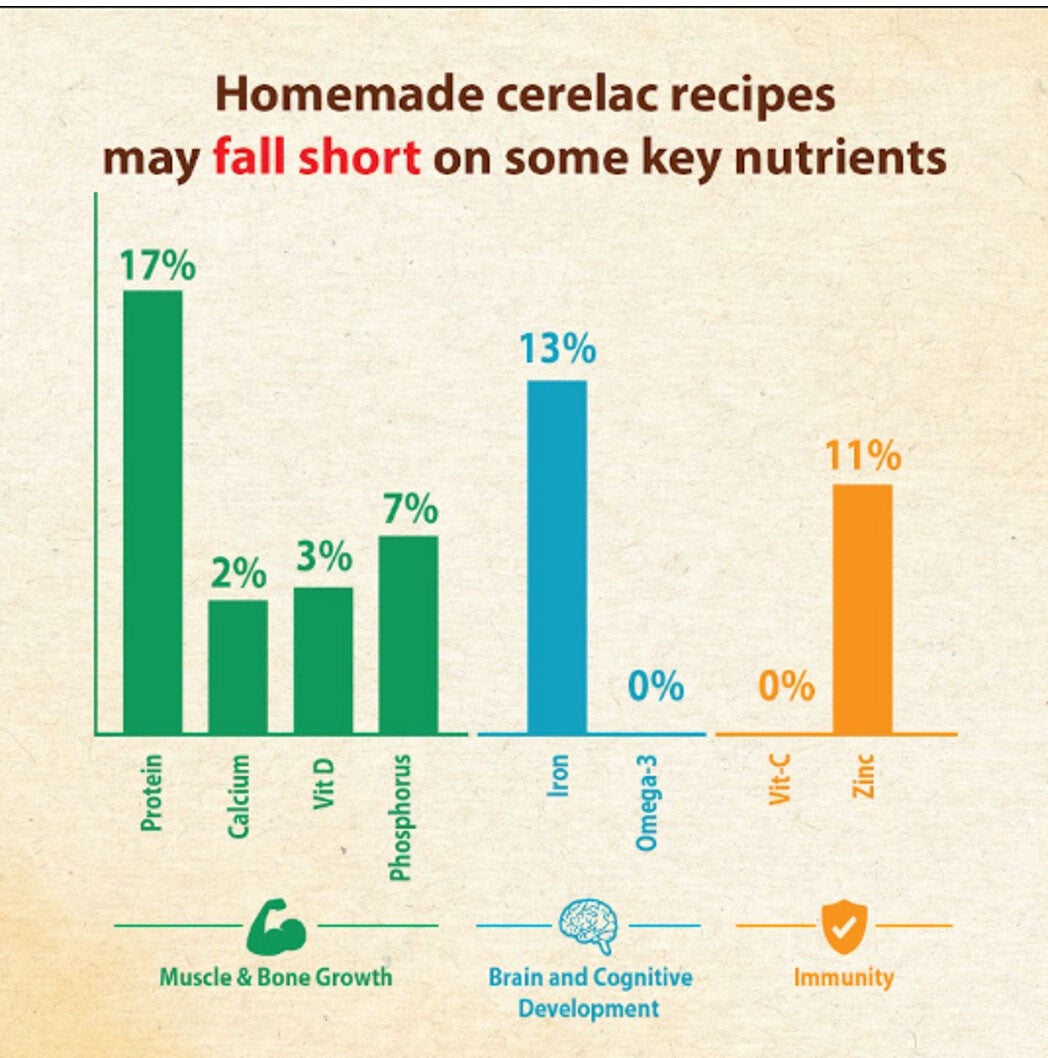
Homemade Cerelac recipes may fall short on some key nutrients
| Benefit | Nutrient | %RDA delivery |
| Bone and Muscle Growth | Protein | 17% |
| Calcium | 2% | |
| Vitamin D | 3% | |
| Phosphorus | 7% | |
| Brain and Cognitive Development | Iron | 13% |
| Omega-3 | 0% | |
| Immunity | Vitamin C | 0% |
| Zinc | 11% |
Always consult your baby's paediatrician before introducing any new food.
Is homemade cerelac recipe safe for babies?
Homemade Cerelac recipes have two important risks that are often overlooked.
Allergens: Ingredients such as almonds, peanuts etc. — commonly used in homemade cerelac recipes—may cause allergic reactions in some babies if introduced all at once.1,2 Especially when multiple allergens are combined in one mix, identifying the cause of a reaction becomes difficult. It is recommended that foods that may trigger allergies should be introduced one at a time.2
Too complex for Immature digestive system: Homemade cerelac recipes trending in India often contain 7+ ingredients mixed together, which may be too complex and difficult to digest for a 6-month-old baby. This is because, at 6 months, an infant’s digestive system is still developing with low levels of digestive enzymes such as salivary amylase and pancreatic amylase.*,3-5
Always consult your baby's paediatrician before introducing any new food.
Homemade Cerelac recipes vs Nestlé CERELAC®: What Is the Difference?
| Factor | Homemade Cerelac recipes | Nestlé CERELAC® |
| Age-Appropriate ingredients | 7+ ingredients may be too complex and difficult to digest for a baby | Yes, made with single grains and fruit for 6 months baby |
| Key Nutrients like Iron, Protein etc. | Generally Low | Rich in Iron & Protein |
| Consistency of nutrition | Inconsistent between batches | Scientifically designed age appropriate recipes |
| Allergens | Ingredients such as almonds, peanuts etc. are commonly used in homemade cerelac — which may cause allergic reactions in some babies if introduced all at once.1,2 | Do not contain common allergens like almonds, peanuts etc. |
| Preservatives / added colours | None | None |
Is Homemade Cerelac recipe Good or Bad for Babies?
Homemade cerelac recipe is not inherently "bad" — but most popular recipes are not age-appropriate for babies starting solids at 6 months.
- Most homemade cerelac recipes contain too many ingredients for a 6-month-old's developing gut
- Paediatric guidelines recommend starting with single foods, not complex multi-ingredient mixes
- They often lack adequate iron, protein, zinc, vitamin D, and other critical micronutrients
Always consult your baby's paediatrician before introducing any new food.
Frequently Asked Questions (FAQ) about Homemade cerelac
Which is better — homemade cerelac recipes or Nestlé CERELAC®?
Both have a role. Nestlé CERELAC® offers age-appropriate, fortified nutrition with No Preservatives and stringent safety tests done on ingredients and final product. Homemade cerelac recipes can be prepared at home but may not contain key micronutrients like Iron, Protein, Zinc, Vitamin D etc. in the required amount and have ingredients like almonds, peanuts etc. which may cause allergic reactions in some babies if introduced all at once.1,2 In addition the multiple ingredients in homemade cerelac recipes might be too complex and make it difficult to digest for babies.*.3-5
Always consult your baby's paediatrician before introducing any new food.

References:
- WHO; [Internet]; Available at: https://iris.who.int/server/api/core/bitstreams/fc78b223-fba2-45a7-bba7-41319dc4bd88/content; Accessed on: 20.02.26
- NHS; [Internet]; Available at: https://www.nhs.uk/baby/weaning-and-feeding/food-allergies-in-babies-and-young-children/; Accessed on: 01.04.26
- Homann C-M, Rossel CA, Dizzell S, Bervoets L, Simioni J, Li J, et al. Infants’ rst solid foods: Impact on gut microbiota development in two intercontinental cohorts. Nutrients. 2021;13(8):2639.
- Shulman RJ. Starch malabsorption in infants. Journal of Pediatric Gastroenterology and Nutrition. 2018 Jun;66:S65-7
- Davis EP, Granger DA. Developmental differences in infant salivary alpha-amylase and cortisol responses to stress. Psychoneuroendocrinology. 2009 Jul 1;34(6):795-804.
- IAP, [Internet], Available at: https://www.bpni.org/Article/nutrition-chapter-IAP-Textbook.pdf, Accessed on: 20.02.26
- Gutema BT, Sorrie MB, Megersa ND, Yesera GE, Yeshitila YG, Pauwels NS, De Henauw S, Abbeddou S. Effects of iron supplementation on cognitive development in school-age children: Systematic review and meta-analysis. PLoS One. 2023 Jun 27;18(6):e0287703.
- Pettoello-Mantovani M, Bali D, Sevketoglu E, Pastore M, Vural M, Giardino I. The first thousand days: nourishing the developing brain for a lifetime of mental well-being. Narrative review. Global Pediatrics. 2025 Jul 21:100270.
- Carr AC, Maggini S. Vitamin C and Immune Function. Nutrients. 2017 Nov 3;9(11):1211.
- Ding M, Ross RP, Dempsey E, Li B, Stanton C. Infant gut microbiome reprogramming following introduction of solid foods (weaning). Gut microbes. 2025 Dec 31;17(1):2571428.
- Bunt V, Visser J, AlRefaee F, Seckel S, Jiang M, Chen J, Zakharova I, Geppe N, Dupont C, Szajewska H, Goossens D. Prevalence and possible causes of crying and mild gastrointestinal and skin symptoms in infants reported by healthcare professionals-worldwide data. European Journal of Pediatrics. 2025 May 14;184(6):341.
Related articles

What Mothers Should Know About Nestlé CERELAC
What is Nestlé CERELAC and when can I give it to my baby?
2 mins to read

Which Nestlé CERELAC Stage Is Right for Your Baby?
Not sure which Nestlé CERELAC stage is right for your baby? Find the right stage, texture and variant here.
2 mins to read

How to Prepare Nestlé CERELAC & How much to feed
Find the full preparation guide and suggested feed quantity for Nestlé CERELAC here.
2 mins to read

Sugar related queries in Nestlé CERELAC
Parents’ questions on CERELAC sugar answered, No Refined Sugar variants, and the difference between total and added sugars
2 mins to read

How we ensure Nestlé CERELAC is safe for your baby
Nestlé CERELAC has NO Preservatives, NO Added Colors, NO Added Flavors, Every ingredient of Nestlé CERELAC undergoes rigorous screening at source and during manufacturing
3 mins to read