


Understanding Baby Diarrhea
Diarrhea may not be the most pleasant part of parenting, but what’s in your baby’s diaper can tell you a lot about their health.
It is one of the most common reasons parents consult pediatricians, especially in the first few years of their baby’s life. Let’s break down what baby diarrhea really is, how to recognize it, what causes it, and when it is time to call the doctor.
What is diarrhea in babies, and how do you know your baby’s stools are not normal?
Baby diarrhea, also called infantile diarrhea, is a very common condition among infants and young children.1
- Medical experts define acute diarrhea as the sudden onset of 3 or more watery or loose stools per day, which typically lasts 7 to 10 days, and at a maximum of 14 days.2
While it may seem like just a minor tummy upset, acute diarrhea is actually the most common gastrointestinal problem in young children and a leading cause of dehydration in babies, especially those under the age of three.3
How do I know if my baby has diarrhea?
Most babies naturally pass soft stools, especially in the first few months. But diarrhea is different; it is watery, happens suddenly, and occurs more frequently than usual. Other signs that often show up in the early stages include:4
- Loss of appetite (anorexia)
- Vomiting
- Abdominal discomfort
- Fever
When is it acute or chronic?
Doctors classify baby diarrhea into:3
- Acute diarrhea: Lasts for 14 days or less
- Chronic or persistent diarrhea: Lasts more than 2 weeks
Doctors may also use the term "persistent diarrhea" to describe long-lasting cases that may be linked to infections or gut damage from poor sanitation (environmental enteric dysfunction).
Common causes of diarrhea in Indian babies: From teething to infections
Can teething cause diarrhea?
Although a lot of parents think that teething causes diarrhea in babies, most medical professionals and research studies conclude that teething does not cause diarrhea. Some babies may experience loose stools around the time when teeth erupt, which is normally a coincidence because of other things such as dietary changes, infection.5
Common Causes of Diarrhea in Babies6
- Infections7
- Viral: Rotavirus is the most common cause of diarrhea in Indian infants. It spreads easily and can lead to dehydration if not managed quickly.
- Bacterial: Common bacteria like E. coli and Salmonella can enter your baby’s stomach through contaminated food and water.
- Food Allergies and Intolerances : Babies may react to certain foods like milk, soy, or fruit sugars (fructose, sucrose). These can lead to gas, bloating, and prolonged loose motions.
- Poor hygiene : Improperly washed bottles, hands, or feeding equipment can introduce harmful microbes.
What Does Diarrhea Poop Look Like in Babies?8
One of the trickiest parts of being a new parent is figuring out what’s normal in your baby’s diaper, especially when it comes to poop.
Here’s what diarrhea poop usually looks like in babies:
- Watery or loose: Much thinner than regular baby poop, often soaking through the diaper.9
- Foul-smelling: It can have a very bad or unusually strong odour.
- Greenish-yellow or Pale yellow in color: These colors may dominate during diarrhea episodes.
- Mucus present: Stools may contain visible mucus, making them slimy or stringy.
- Undigested food particles: Especially in older infants on solids, food may pass through the gut too quickly to be broken down properly.
- Frequent and sudden: Diarrhea happens more often than your baby’s usual stooling pattern.
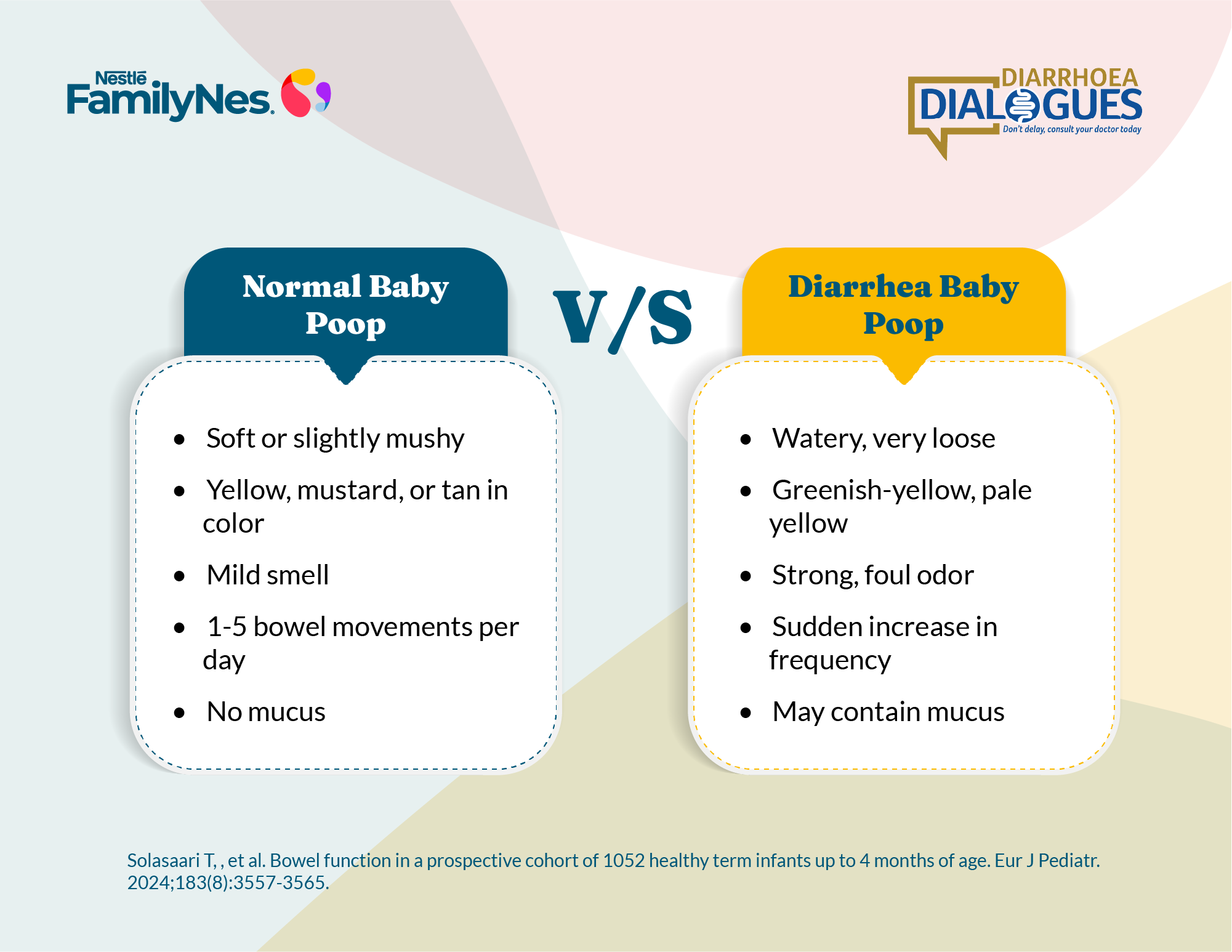
It’s normal to stressed over your baby’s diaper, but now you know how to recognize true diarrhea, understand what causes it, and identify when it’s serious. Simple preventive steps like good hygiene, safe drinking water, and rotavirus vaccination, can make a big difference in your baby’s gut health.
If your baby’s diarrhea persists for longer than a day, displays signs of dehydration, or seems off, contact your pediatrician.
References
- Thiagarajah JR, Kamin DS, Acra S, et al. Advances in Evaluation of Chronic Diarrhea in Infants. Gastroenterology. 2018;154(8):2045-2059.e6. doi:10.1053/j.gastro.2018.03.067
- Radlović N, Leković Z, Vuletić B, Radlović V, Simić D. Acute Diarrhea in Children. Srp Arh Celok Lek. 2015;143(11-12):755-762. doi:10.2298/sarh1512755r
- Nemeth V, Pfleghaar N. Diarrhea. In: StatPearls. StatPearls Publishing; 2025. Accessed July 21, 2025. http://www.ncbi.nlm.nih.gov/books/NBK448082/
- Dehydration and diarrhea. Paediatr Child Health. 2003;8(7):459-460. doi:10.1093/pch/8.7.459
- Noor-Mohammed R, Basha S. Teething disturbances; prevalence of objective manifestations in children under age 4 months to 36 months. Med Oral Patol Oral Cir Bucal. 2012;17(3):e491-e494. doi:10.4317/medoral.17487
- Symptoms & Causes of Chronic Diarrhea in Children - NIDDK. National Institute of Diabetes and Digestive and Kidney Diseases. Accessed July 21, 2025. https://www.niddk.nih.gov/health-information/digestive-diseases/chronic…
- Cohen MB. Etiology and mechanisms of acute infectious diarrhea in infants in the United States. J Pediatr. 1991;118(4 Pt 2):S34-39. doi:10.1016/s0022-3476(05)81423-4
- Solasaari T, Korpela K, Lommi S, et al. Bowel function in a prospective cohort of 1052 healthy term infants up to 4 months of age. Eur J Pediatr. 2024;183(8):3557-3565. doi:10.1007/s00431-024-05625-0
- Shah D, Sharma N, Rai AK, Oberoi A. Indian Academy of Pediatrics (IAP).
This content is not a substitute for professional medical advice. Please consult your healthcare professional.
Disclaimer: Mothers are informed that breast milk, especially the yellowish colostrum secreted in the first week after delivery, is highly nutritious and contains more protein, anti-infective properties, and Vitamin A. Breast milk is a complete food for the first six months, protects against infections, is always available, and requires no preparation. It is also more economical than infant milk substitutes.
Breastfeeding immediately after delivery helps the womb contract and supports the mother in regaining her figure quickly. Frequent suckling and maternal confidence are key to success. Mothers should be encouraged and supported, with proper care of breasts during pregnancy. Infants should be breastfed as soon as possible after birth, and mother and child should stay together (rooming-in). Colostrum must be given and not discarded in favor of sugar water or other substitutes. Infants should be fed on demand, and hygiene for both mother and child must be maintained.