


Watching your baby lift their head, roll over, sit, crawl, and take those first little steps is exciting for every parent. These are called physical milestones, and they show that your baby’s muscles, bones, and brain are growing well. To reach these milestones, your baby needs essential nutrients, and protein plays a major role.
Did you know that protein is one of the key building blocks for your child’s healthy growth and development?
Protein helps in forming muscles, supporting physical development, strengthening immunity, and even aiding brain function that eventually have a role in supporting baby’s development and milestones. While your baby’s milestones like rolling, sitting, crawling, and walking are governed by many factors, protein plays an important role as a key component for healthy growth.
Baby Growth Milestones (0–12 Months)
Every baby grows at their own pace, but here are some common developmental milestones:
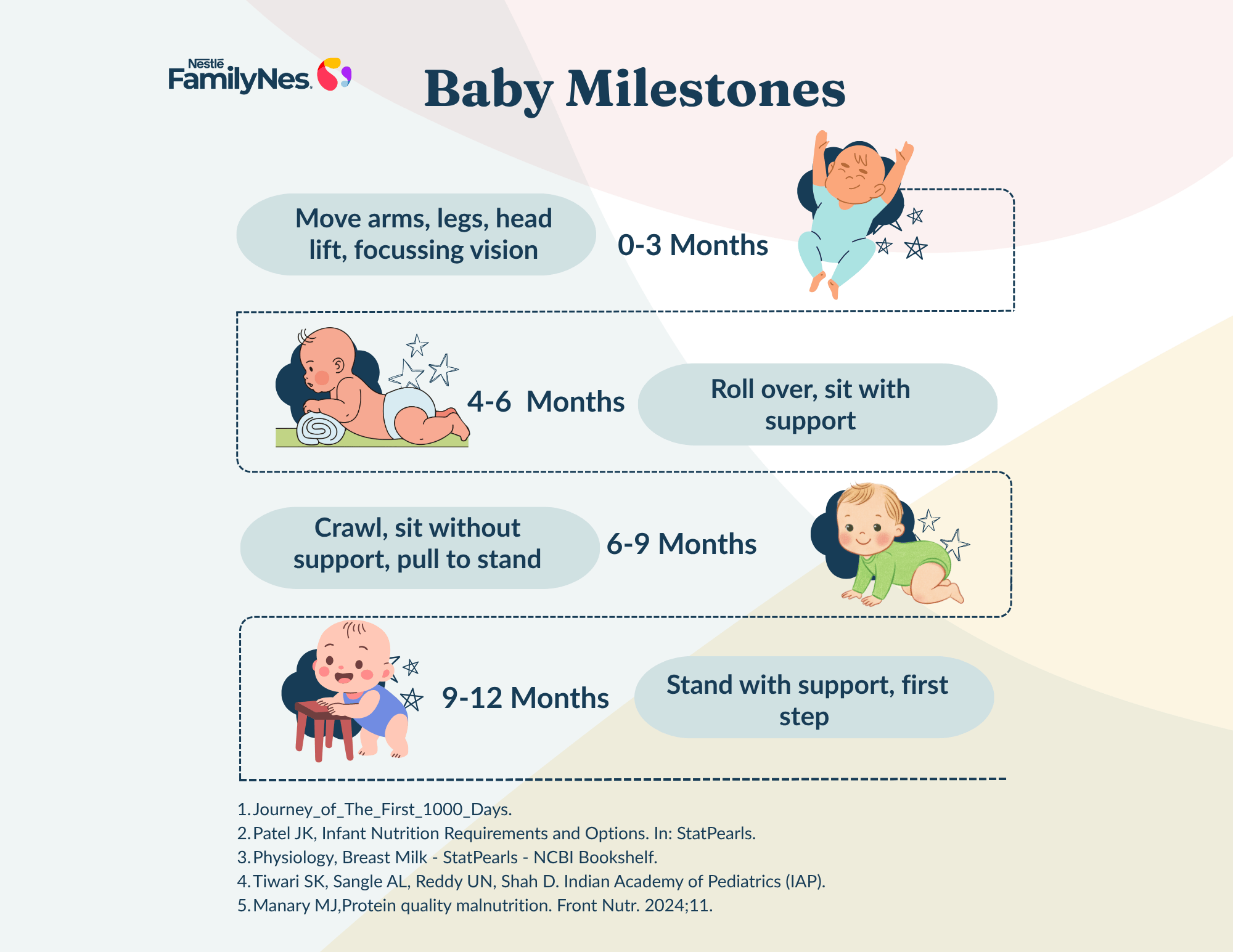
Age Group | What Babies Achieve | Nutrition That Supports |
| 0-3 months | Babies begin to lift their heads, move their arms and legs, and focus their vision.1 | Breastmilk provides the ideal balance of proteins, which are easy to digest and support early growth.2 |
| 4-6 months | Babies may start rolling over, sitting with support, and improve brain and muscle development.3 | Exclusive breastfeeding till 6 months ensures your baby gets all the essential amino acids for muscle and brain development.4 |
| 6-9 months | Crawling, sitting without support, and pulling up to stand are common at this stage.1 | After 6 months, continue breastfeeding and add start complementary foods. Include a variety of soft foods for overall nutrition, with options like pulses, curd, paneer, or well-cooked egg yolk to add extra protein to your baby’s diet.5 |
| 9-12 months | Many babies start cruising or taking their first steps. | Together with milk, offer simple meals such as khichdi with curd, or mashed egg/chicken. These provide a mix of nutrients for energy, immunity, and brain development, while the added protein helps build strength and coordination during this active stage.6, 5 |
Breastmilk: The Ideal Protein Source
“Breastmilk gives the best quality and easily absorbable protein, perfectly designed for your baby’s needs.”
For the first six months, breastmilk is the best source of protein for your baby. It is uniquely designed with the ideal balance of whey and casein proteins in approximately 72:28 ratio. Whey protein is easy to digest, making breastmilk gentle on your baby’s tummy. In contrast, bovine milk has this ratio reversed, i.e, it is more casein predominant.7
Breastmilk also provides all the essential amino acids your baby cannot produce on their own, in the perfect proportion. Because its proteins are highly bioavailable, your baby’s body can absorb and use them effectively.
The Importance of Protein Quality, Quantity, and Absorption7
For healthy growth, your baby needs to have enough protein (quantity), as well as the right kind (quality)-they require proteins with all the essential amino acids that the body cannot produce on its own and are easily absorbed (high bioavailability), which means your baby’s body can use it fully.
Once your baby is 6 months old, solids help provide additional essential amino acids. Examples of high-quality protein sources include eggs, milk, fish, and chicken. Plant proteins can also be made complete when combined smartly, like dal + rice or khichdi with curd.
Risks of Low or Excess Protein Intake8
Too little quality protein in the first year can lead to stunting (low height for age), affect brain development, and reduced immunity. This is why filling foods like watery dal or plain rice are not enough; they may fill the stomach, but do not give the essential amino acids your baby needs for proper growth.
On the other hand, excess protein intake may also lead to a faster rate of weight gain, which may lead to increased obesity risk later in life. Babies need protein in the right amount and right quality, not too little or too much.9
Protein is a vital nutrient; it is one of the key building blocks of your baby’s muscles, brain connections, and movement skills. Give your baby the right kind and amount of protein every day.
Tell us what you think
It only takes a few seconds and helps us support you better

References
- Journey_of_The_First_1000_Days.
- Patel JK, Rouster AS. Infant Nutrition Requirements and Options. In: StatPearls. StatPearls Publishing; 2025. Accessed September 2, 2025. http://www.ncbi.nlm.nih.gov/books/NBK560758/
- Physiology, Breast Milk - StatPearls - NCBI Bookshelf. September 2, 2025. Accessed September 2, 2025. https://www.ncbi.nlm.nih.gov/books/NBK539790/
- The effect of brain -derived neurotrophic factor on motor development and its relation to the pattern of feeding in early infancy | Request PDF. ResearchGate. Published online August 6, 2025. doi:10.4103/sjamf.sjamf_135_20
- Tiwari SK, Sangle AL, Reddy UN, Shah D. Indian Academy of Pediatrics (IAP).
- Manary MJ, Wegner DR, Maleta K. Protein quality malnutrition. Front Nutr. 2024;11. doi:10.3389/fnut.2024.1428810
- Tang M. Protein Intake during the First Two Years of Life and Its Association with Growth and Risk of Overweight. Int J Environ Res Public Health. 2018;15(8):1742. doi:10.3390/ijerph15081742
- Rizky Maulidiana A, Sutjiati E. Low intake of essential amino acids and other risk factors of stunting among under-five children in Malang City, East Java, Indonesia. J Public Health Res. 2021;10(2):2161. doi:10.4081/jphr.2021.2161
- Weber M, Grote V, Closa-Monasterolo R, et al. Lower protein content in infant formula reduces BMI and obesity risk at school age: follow-up of a randomized trial. Am J Clin Nutr. 2014;99(5):1041-1051. doi:10.3945/ajcn.113.064071
Important Notice
This content is not a substitute for professional medical advice. Please consult your healthcare professional.
Disclaimer: Mothers are informed that breast milk, especially the yellowish colostrum secreted in the first week after delivery, is highly nutritious and contains more protein, anti-infective properties, and Vitamin A. Breast milk is a complete food for the first six months, protects against infections, is always available, and requires no preparation. It is also more economical than infant milk substitutes.
Breastfeeding immediately after delivery helps the womb contract and supports the mother in regaining her figure quickly. Frequent suckling and maternal confidence are key to success. Mothers should be encouraged and supported, with proper care of breasts during pregnancy. Infants should be breastfed as soon as possible after birth, and mother and child should stay together (rooming-in). Colostrum must be given and not discarded in favor of sugar water or other substitutes. Infants should be fed on demand, and hygiene for both mother and child must be maintained.