


Not All Proteins Are Equal: Why Protein Quality Matters Most in Baby Nutrition
Is Your Baby Getting the Right Kind of Protein?
Babies have rapid physical and mental development during the first 12 months of life. Protein is an important nutrient to add to your baby's diet during all the stages of their growth. It helps in muscle building, immunity, brain development, and the overall growth and development of your baby. Protein makes up about 15% of a baby's total energy intake. But it's not just the amount of protein that matters; the quality of protein is just as important to make sure the babies get the right building blocks they need to grow well.
What Makes a Protein 'High Quality'?
Protein quality refers to how well a protein source provides the essential amino acids (EAA) that the body needs for growth and development. These amino acids play a major role in forming muscles, repairing tissues, and producing enzymes and hormones that keep the body functioning properly.
How Experts Measure Protein Quality
Metric | What It Measures |
|---|---|
| Biological Value (BV) | How much of the protein is used by the body |
| Protein Efficiency Ratio (PER) | How well it supports growth and weight gain |
| Net Protein Utilization (NPU) | How much protein eaten is kept in the body for building |
Proteins like whey score high in all of these, which is why they are considered high-quality for babies.
Key Definition: Essential Amino Acids (EAA)
There are a total of 20 amino acids known, and our body can make only 11 on its own, while the other 9 amino acids, which we should get from our diet, are known as the essential amino acids.
Complete vs. Incomplete Protein: What Is the Difference?
Not all proteins provide the same benefits, especially when it comes to infants who need precise nutrition for healthy growth.
Feature | High-Quality (Complete) Protein | Low-Quality (Incomplete) Protein |
|---|---|---|
| Essential amino acids | All 9 present | One or more missing |
| Digestibility | Easily digested | Harder to digest |
| Food combining needed | No pairing needed | Often needs pairing |
| Common sources | Breast milk, eggs, dairy | Lentils, beans, cereals, grains |
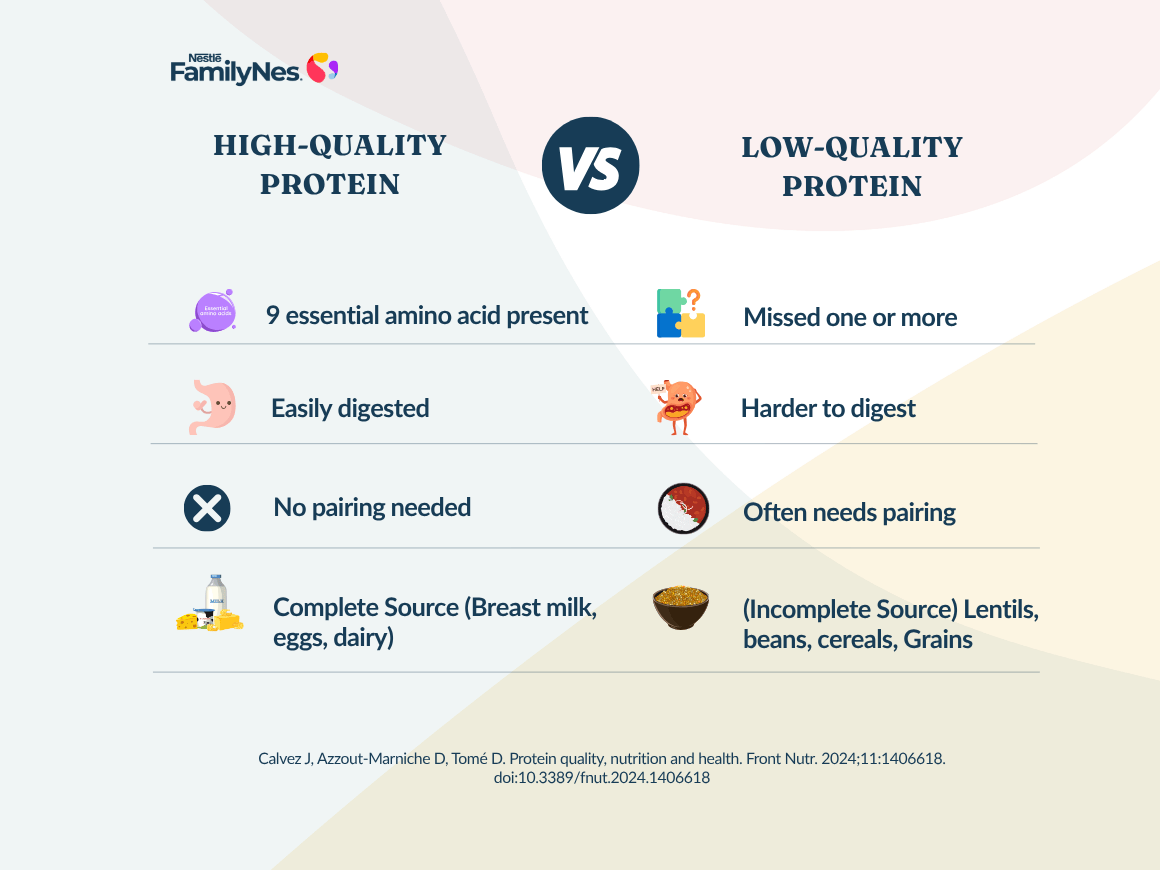
A protein that contains all 9 of these EAA in the right proportions is called a high-quality or complete protein. This is especially important for infants, whose fast-growing bodies need these nutrients in balanced amounts.
Incomplete protein foods, such as plant-based proteins that do not contain all the EAA, are called incomplete proteins. However, combining different plant-based foods can help to complete the protein profile.
Why Amino Acids Matter for Growing Babies
Amino acids are the tiny building blocks that come together to form protein — one of the most important nutrients for your baby's growth. They help build and repair tissues like muscles, skin, and even the brain.
Key Amino Acids and Their Roles in Infant Development
Amino Acid | Role in Baby's Growth |
|---|---|
| Glutamine | Strengthens the immune system |
| Tryptophan | Contributes to brain development and function |
| Lysine | Linked to the release of growth hormones |
| Arginine | Linked to the release of growth hormones |
Together, these help ensure your baby grows strong, healthy, and well-developed in their first year of life.
Breast Milk: Nature's Perfect Protein Source
Breast milk can meet all of your baby's nutritional needs, especially when it comes to protein during the first 6 months of life. It contains a perfect balance of two key proteins: whey and casein. The whey-to-casein ratio is around 72:28, making it very easy for newborns to digest. Whey is also considered a high-quality protein.
One of the major advantages of breast milk is its unique balance of proteins compared to cow's milk. The whey-to-casein ratio in breast milk makes it much easier for infants to digest. This balanced protein profile provides all the vital amino acids needed for robust immunity, healthy growth, and brain development. It has optimal concentrations of essential amino acids that are critical for early growth, such as tryptophan, lysine, and leucine.
Doctors recommend exclusive breastfeeding for a child till 6 months of age as it is a complete food for your growing baby till that time.
When Breastfeeding Is Not Possible
When breastfeeding is not possible, seek your paediatrician's guidance to choose an alternative milk diet that is close to the nutritional profile of breast milk, especially in protein composition, and is easily digestible.
These are fortified with the essential amino acids to support healthy growth, brain development, and immune function, just like breast milk. The main protein components, whey and casein, are added and adjusted in a composition similar to breastmilk to match the digestibility and amino acid profile.
Always ensure the milk diets are age-appropriate and chosen based on your pediatrician's guidance, as infant nutritional needs vary with age and developmental stage.
Grain + Pulse: A Traditional Indian Protein Powerhouse
In most Indian households, grains and pulses form the base of everyday meals. On their own, they don't provide all the essential amino acids that babies need for proper growth. But when combined, they complement each other beautifully to form a more complete protein source.
Common Indian Protein-Combining Combinations
Food | Type | Role |
|---|---|---|
| Moong dal, chickpeas, peas, kidney beans | Pulses | Rich in protein and fibre |
| Rice, wheat, millets | Grains | Provide energy and nutrients |
| Dal-chawal, khichdi, roti with sabzi | Combined meal | Balanced, more complete protein |
| Amaranth (rajgira) | Pseudo-cereal | High protein with better amino acid profile |
Together in dishes like dal-chawal, khichdi, or roti with sabzi, they balance each other out and naturally improve the quality of protein in your baby's diet. Pseudo-cereals like Amaranth (rajgira) are high in protein with a better amino acid profile.
Final Thoughts
A balanced diet with appropriate nutrients from the early years of growth is a foundation for lifelong good health for your baby. Understanding the simple basics of your baby's diet and making small changes can help your baby grow healthy and happy and will keep you worry-free.
Tell us what you think
It only takes a few seconds and helps us support you better

References
- Malik F, Marwaha R. Developmental Stages of Social Emotional Development in Children. In: StatPearls. StatPearls Publishing; 2025. Accessed August 4, 2025. http://www.ncbi.nlm.nih.gov/books/NBK534819/
- Patel JK, Rouster AS. Infant Nutrition Requirements and Options. In: StatPearls. StatPearls Publishing; 2025. Accessed August 4, 2025. http://www.ncbi.nlm.nih.gov/books/NBK560758/
- Katz DL, Doughty KN, Geagan K, Jenkins DA, Gardner CD. Perspective: The Public Health Case for Modernizing the Definition of Protein Quality. Advances in Nutrition. 2019;10(5):755-764. doi:10.1093/advances/nmz023
- Kaur Arora S. An Overview of Importance and Nutritional Evaluation of Food Protein Quality. Act Scie Nutr. 2023;7(7):96-101. doi:10.31080/ASNH.2023.07.1269
- Calvez J, Azzout-Marniche D, Tomé D. Protein quality, nutrition and health. Front Nutr. 2024;11:1406618. doi:10.3389/fnut.2024.1406618
- Uauy R, Kurpad A, Tano-Debrah K, et al. Role of Protein and Amino Acids in Infant and Young Child Nutrition: Protein and Amino Acid Needs and Relationship with Child Growth. J Nutr Sci Vitaminol (Tokyo). 2015;61 Suppl:S192-194. doi:10.3177/jnsv.61.S192
- Moughan PJ, Deglaire A, Yan Y, et al. Amino acid requirements of the infant: the amino acid composition of human breast milk. Front Nutr. 2024;11. doi:10.3389/fnut.2024.1446565
- Li J, Zhu F. Protein factors affecting the quality of infant formula: optimization, limitations, and opportunities. Current Opinion in Food Science. 2025;62:101264. doi:10.1016/j.cofs.2024.101264
- Bouchard J, Malalgoda M, Storsley J, Malunga L, Netticadan T, Thandapilly SJ. Health Benefits of Cereal Grain- and Pulse-Derived Proteins. Molecules. 2022;27(12):3746. doi:10.3390/molecules27123746
- Zhang W, Boateng ID, Xu J, Zhang Y. Proteins from Legumes, Cereals, and Pseudo-Cereals: Composition, Modification, Bioactivities, and Applications. Foods. 2024;13(13):1974. doi:10.3390/foods13131974
Important Notice
This content is not a substitute for professional medical advice. Please consult your healthcare professional.
Disclaimer: Mothers are informed that breast milk, especially the yellowish colostrum secreted in the first week after delivery, is highly nutritious and contains more protein, anti-infective properties, and Vitamin A. Breast milk is a complete food for the first six months, protects against infections, is always available, and requires no preparation. It is also more economical than infant milk substitutes.
Breastfeeding immediately after delivery helps the womb contract and supports the mother in regaining her figure quickly. Frequent suckling and maternal confidence are key to success. Mothers should be encouraged and supported, with proper care of breasts during pregnancy. Infants should be breastfed as soon as possible after birth, and mother and child should stay together (rooming-in). Colostrum must be given and not discarded in favor of sugar water or other substitutes. Infants should be fed on demand, and hygiene for both mother and child must be maintained.
Frequently Asked Questions (FAQs)
What is the difference between complete and incomplete protein for babies?
A complete protein contains all 9 essential amino acids in the right proportions and is easily digested, making it ideal for infants. An incomplete protein is missing one or more essential amino acids — plant-based foods like lentils, beans, and cereals often fall into this category, but combining them (e.g., rice and dal) can create a more complete protein profile.
Why is protein quality important in infant nutrition?
Protein quality determines how effectively a protein source delivers the essential amino acids infants need for muscle building, brain development, immunity, and tissue repair. High-quality proteins are fully utilised by the body; low-quality proteins may leave nutritional gaps even if the quantity appears adequate.
Is breast milk a high-quality protein source for babies?
Yes. Breast milk is considered nature's perfect protein source for infants. Its approximately 72:28 whey-to-casein ratio makes it highly digestible and provides all the vital amino acids - including tryptophan, lysine, and leucine - critical for early growth, brain development, and immunity.
What should I feed my baby if breastfeeding is not possible?
Consult your paediatrician for guidance on age-appropriate alternatives that closely match breast milk's protein composition. Suitable options are typically fortified with essential amino acids and have whey and casein adjusted to mirror the digestibility and amino acid profile of breast milk.
Which Indian foods provide high-quality protein for babies?
Combining grains and pulses creates a more complete protein source. Good combinations include dal-chawal (rice and lentils), khichdi, and roti with dal or sabzi. Pseudo-cereals like amaranth (rajgira) also offer a higher protein content with a better amino acid profile than most grains.
What are essential amino acids, and why do babies need all 9?
Essential amino acids (EAAs) are the 9 amino acids the body cannot produce on its own and must obtain from food. For rapidly growing infants, all 9 EAAs must be available simultaneously and in the right proportions to support muscle growth, brain function, immune strength, and tissue repair.